
Introduction
There is a well-documented gap in implant education between what dentists understand after completing a course and what they can execute independently. Lecture-based and typodont training build the foundation. Live patient training is where that foundation is tested — and where it either holds or reveals itself as incomplete.
For dentists evaluating implant CE programs, understanding what live patient training actually involves is essential to assessing whether a program will deliver meaningful preparation. This article covers case selection, supervision structure, what participants need to know before showing up, and where first-case difficulty typically appears.
Case Selection: How Patients Are Screened for Training Cases
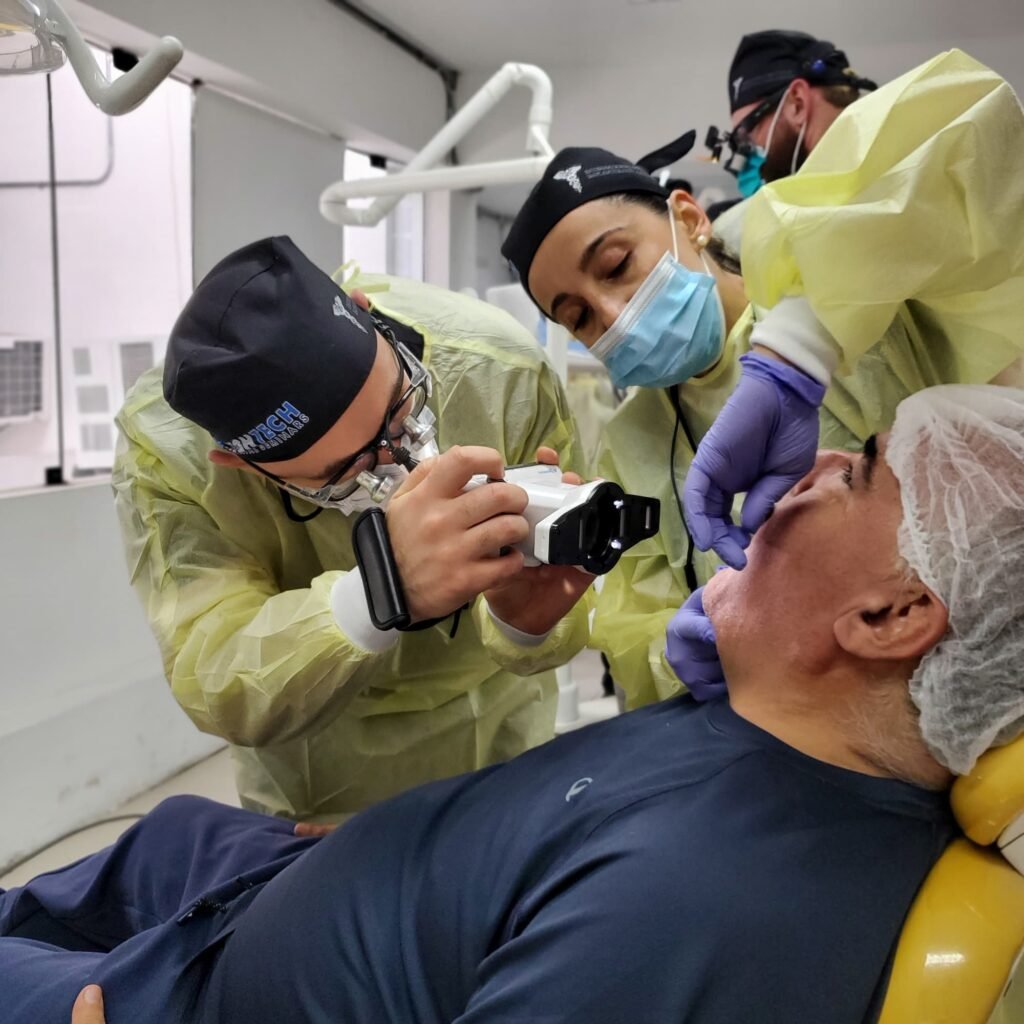
Live patient cases in structured implant programs are not unfiltered clinical complexity. Faculty-led programs screen cases to match participant experience. For foundational courses, this typically means:
- Single-unit posterior placements — most commonly mandibular premolar or molar sites with adequate bone volume
- Healed extraction sockets — cases without simultaneous bone grafting or complex soft tissue management
- Patients with ASA Class I or II medical status — no active systemic conditions requiring modified anaesthesia protocols
- Bone volume confirmed on CBCT — typically 6mm minimum width and 10mm height clearance above the inferior alveolar nerve or sinus floor
This case selection is deliberate. It removes variables that require clinical judgment the participant has not yet developed, allowing focus on surgical execution: drilling sequence, angulation, depth control, and torque application.
The Supervision Structure: What Faculty Involvement Looks Like
The quality of live patient training correlates directly with supervision density. The participant-to-faculty ratio during live cases is the single most important structural variable in evaluating a program.
Pre-Surgical Briefing
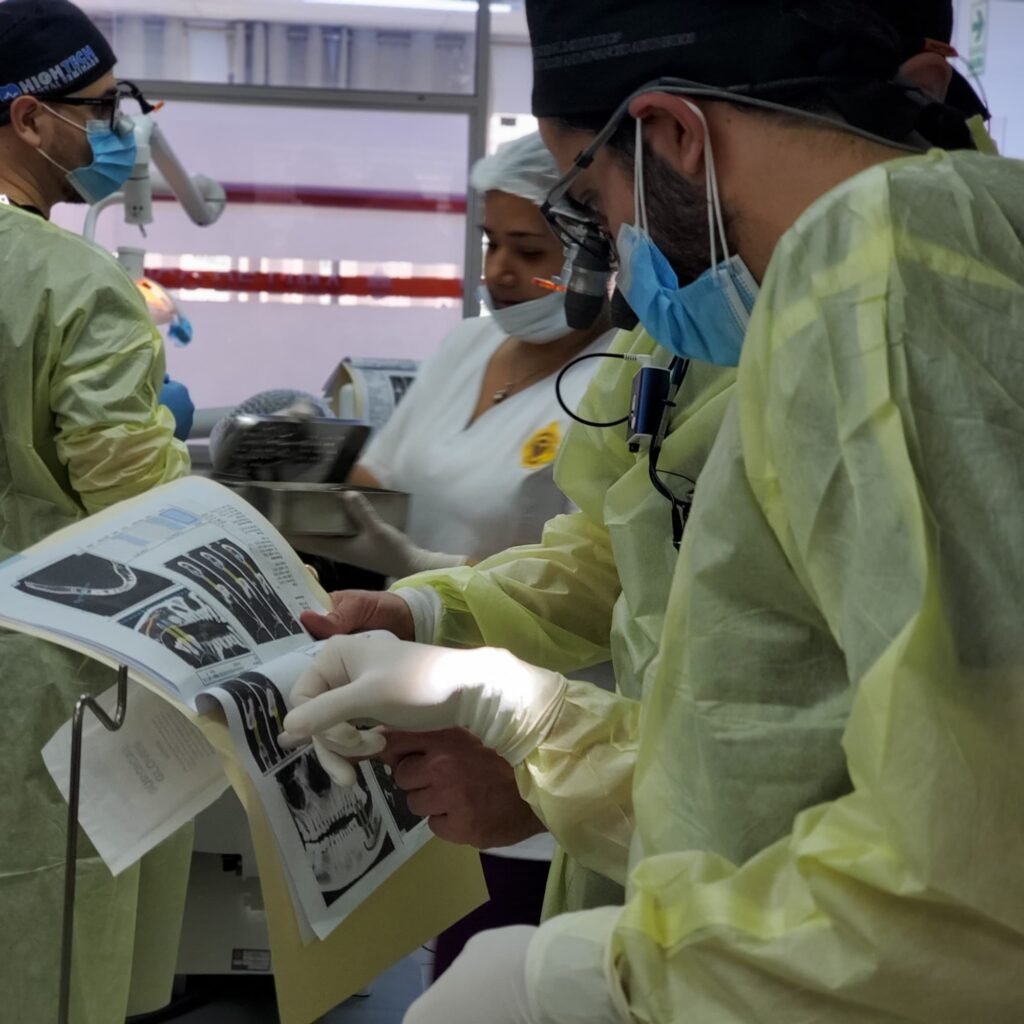
Before the first live patient case, participants review the specific case with faculty — CBCT analysis, implant selection, planned angulation, and depth targets. This is case-specific surgical planning, not a general didactic session.
Intraoperative Checkpoints
During the procedure, faculty are present chairside. In well-structured programs, one faculty member supervises no more than two to three participants during active surgical phases. Specific checkpoints include:
- Soft tissue incision and flap design — faculty confirm flap access before drilling begins
- Pilot drill placement — angulation and depth confirmed radiographically or with a direction indicator before progressing
- Sequential osteotomy preparation — drilling technique, irrigation, and tactile feedback interpretation reviewed at each step
- Implant seating and primary stability assessment — torque values and ISQ readings reviewed with faculty
- Closure — suturing technique supervised and corrected in real time.
Post-Surgical Debrief
Immediately following each case, faculty conduct a structured review: what went according to plan, where deviations occurred, and what the participant should adjust in subsequent cases. This debrief is where learning transfers from the case to the participant’s independent practice framework.
What Participants Are Expected to Know Before Live Cases Begin
Live patient training is not remedial instruction. Programs that use it effectively assume specific preparation has been completed:
- Anatomy — mandibular and maxillary implant sites, nerve anatomy, sinus floor relationships, cortical plate positions
- Drilling protocol — the specific sequence and dimensions for the implant system used in the course
- Primary stability targets — torque thresholds typically 25–45 Ncm and ISQ ranges typically 55–80, used to determine immediate versus delayed loading decisions
- Prosthetic sequencing — enough understanding of the restorative workflow to appreciate how placement decisions affect the prosthetic outcome
Participants who arrive at live patient sessions without this preparation slow the surgical workflow and are more likely to require faculty intervention at basic steps. Pre-course preparation directly determines what participants take away from supervised cases.
Where First-Case Difficulty Typically Appears
The following challenges appear consistently in first-case participants across structured implant programs. Faculty anticipate these. Participants who do too are better positioned.
Drilling Angulation
Maintaining planned angulation across the full drilling sequence is the most common first-case difficulty. On a typodont, there is no soft tissue resistance or patient movement. On a live patient, small angulation errors compound across the drilling sequence and are difficult to correct after the pilot drill is placed. Pre-course drilling repetition on bone models consistently correlates with better first-case angulation outcomes.
Tactile Feedback Interpretation
Distinguishing normal cortical resistance from unexpected density changes, proximity to adjacent roots, or inadequate irrigation requires experience that typodont training only partially approximates. Faculty guide interpretation during the case, but this skill is not fully developed after a single supervised placement.
Flap Management
Adequate flap design and tension-free closure are consistently underemphasized in pre-course preparation. Participants who have reviewed flap design for implant placement before the course are better positioned to execute this independently.
What Live Patient Training Does Not Prepare Dentists For
A structured live patient course is necessary but not sufficient for independent implant practice. It does not address:
- Complex case management — simultaneous grafting, immediate placement, full-arch cases, or patients with medically modified protocols
- Complication management at the point of care — this requires additional case volume and ideally post-course mentorship
- Independent patient selection and treatment planning — course cases are pre-selected by faculty; independent practice requires the clinician to make these assessments without that scaffold
Dentists who complete live patient training with appropriate case repetition and post-course mentorship are typically positioned to begin independent practice with lower-complexity single-unit cases. More complex case types require additional supervised exposure.
What HTDS Guarantees on Placement Volume
The framework above — case selection, supervision ratio, pre-course preparation, structured debrief — gives dentists the right questions. The HTDS Canada residency program answers the most important one directly.
Each participant in the HTDS live patient implant training residency performs a minimum of five implant placements and assists on five additional cases — ten total implant exposures per dentist. That is not a course description or a typical outcome. It is a guaranteed minimum built into the program structure.
The distinction matters. A program that offers live patient experience and a program that guarantees a specific placement floor are meaningfully different things. The first depends on case availability and cohort dynamics. The second removes that variable and commits to a defined outcome.
For dentists evaluating whether a live patient course will actually prepare them for independent practice, placement volume is the most direct answer to that question. Five performed placements with structured faculty supervision represents a more defensible baseline for starting independent single-unit cases than one or two.
Clinical Takeaway
Live patient dental implant training provides the procedural validation that typodont and lecture-based formats cannot. The variables that determine its value are specific: case selection matched to participant experience, a supervision ratio that allows real-time correction, structured pre-surgical and post-surgical debrief, and participant preparation that allows surgical focus rather than basic protocol review.
The HTDS Canada residency is structured around those variables — and guarantees the placement volume that makes them matter.
For full details on the HTDS live patient training format and Canada residency placement guarantee, see the Hands-On Implant Courses page and the Dental Implant Training overview.