
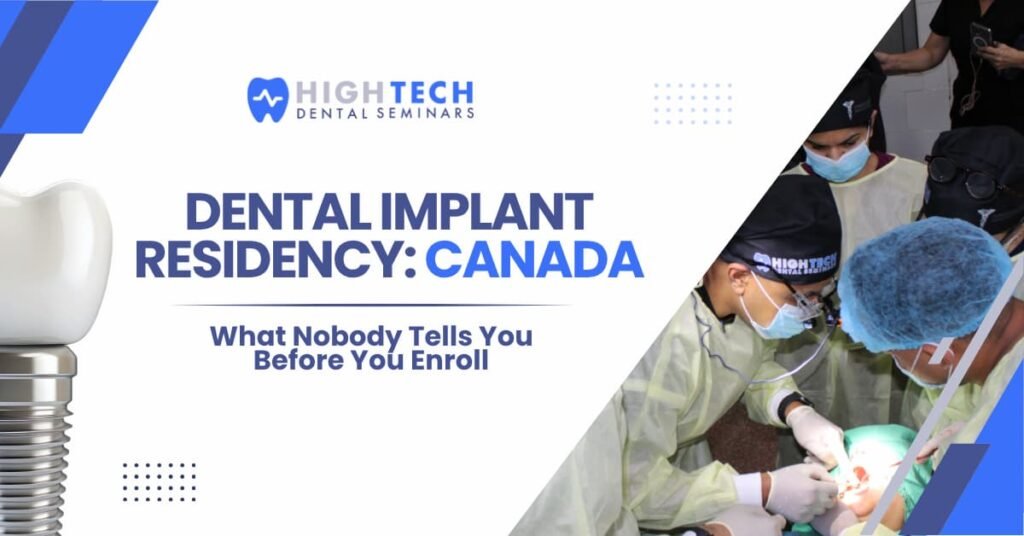
Before enrolling in a dental implant residency in Canada, ask six questions in writing: how many implants you will personally place on live patients, how placing compares with assisting, what tuition includes, who provides the patients and where surgery happens, how the program aligns with your regulator’s training requirements, and what support you get after graduation. Clear, specific answers let you compare programs fairly. This guide explains why each question matters and how the HTDS Canada implant residency answers them.
Why Evaluating an Implant Residency Matters
For general dentists adding surgical implant placement to their scope, an implant residency is often one of the largest continuing education decisions they make, in time, tuition, and clinical responsibility. Program materials vary widely in how specifically they describe live surgery, costs, and support. Asking the same questions of every implant residency program in Canada makes the comparison concrete.
Question 1: How Many Live Placements Are Guaranteed?
This is often the most important question. A workshop day is not a surgical case, and observation is not operative experience. Watch for range language such as “approximately 8 to 12 cases” or “up to 10 placements”. A range describes a ceiling, not a floor.
A well-structured program states a minimum number of live implant placements every participant will personally perform, regardless of patient flow or cohort size.
How HTDS answers it: the Step-by-Step Dental Implants Training residency guarantees each participant a minimum of 5 implants they personally place and 5 they assist on, all on live patients. The course also includes live patient exposure to advanced procedures, including sinus lifts, bone grafting, ridge augmentation, immediate placements, and full arch surgery.
Question 2: Are You Placing or Assisting, and What Is the Ratio?
Assisting has value: watching an experienced surgeon manage tissue, the drill sequence, and complications builds a procedural map. But assisting does not build the tactile feedback and decision-making that come only from operating. Ask for the split between placed and assisted cases.
Also ask how faculty supervise during surgery. For a dentist placing first implants, the concern is often an unexpected finding, such as a sinus membrane perforation or an unexpected anatomical variation. Supervision should be hands-on and intraoperative, with an experienced clinician in a position to step in.
How HTDS answers it: 5 placed and 5 assisted, a 1:1 ratio written into the program structure. HTDS states that faculty supervision during surgery is hands-on and intraoperative.
Question 3: What Does the Tuition Actually Include?
Advertised tuition often covers instruction only. Ask whether these are included or billed separately:
Cost item | Ask whether it is included |
Implant fixtures and surgical kits | Included or billed per implant? |
Bone graft materials and membranes | Included or extra? |
Laboratory fees for restorations | Included or extra? |
Facility or sterilization fees | Included or extra? |
Staff training | Included, and for how many people? |
Travel and accommodation | Needed for any part of the program? |
A program with lower tuition and separately billed materials may cost more overall than an all-inclusive program. Compare the total cost to completion.
How HTDS answers it: tuition is $15,900 CAD + HST and includes all clinical patients, Astra Tech implant fixtures, bone graft materials, membranes, lab fees, surgical kits, and a one-day staff training workshop for up to 3 team members. Payment plans are available.
Question 4: Who Provides the Patients, and Where Is the Surgery?
Some programs ask participants to bring their own patients. That model can support continuity of care, but it assumes a dentist new to implants can already select suitable surgical cases, which is one of the skills the residency is meant to teach.
Also ask where live surgery happens. Some programs complete classroom and model work in Canada but require travel abroad for live patient surgery, sometimes as a separately priced component.
How HTDS answers it: the program provides all patients for the clinical component, and participants may optionally bring up to 2 of their own patients. Lectures and workshops are held at the Dentsply Sirona Academy in Mississauga, and live patient surgery takes place at Barton Dental in Hamilton, Ontario.
Question 5: How Does the Program Align With Regulatory Training Requirements?
In Ontario, the RCDSO’s Educational Requirements and Professional Responsibilities for Implant Dentistry set minimum initial training for dentists who are not specialists and expect additional training before complex cases. RCDSO has also consulted on an updated Implant Dentistry Standard of Practice, which states that RCDSO does not approve courses and that dentists should compare a course’s learning outcomes against the Standard themselves. Dentists in other provinces should check their own regulator’s requirements.
Ask each program for its curriculum, hours by surgical and prosthetic phase, and CE credit count in writing, so you can check them against your regulator’s requirements.
How HTDS answers it: the residency awards 140 Category 2 CE credits and covers both the surgical and prosthetic phases across six modules, from treatment planning through implant exposure and final restoration. Graduates also receive an ICOI Fellowship Certificate. HTDS is a nationally approved AGD PACE program provider; that approval does not imply acceptance by any regulatory authority.
Question 6: What Happens After You Graduate?
A certificate marks the end of the course, not the end of the learning curve. Clinical judgment develops through repetition, and early independent cases are when experienced advice is most useful. Ask what post-course support looks like: who provides it, how you reach them, and for how long.
How HTDS answers it: graduates have direct post-course mentorship from Dr. Ahmed Ameen Al-Obaidi, the program’s lead instructor and an RCDSO-licensed dentist practising in Ontario, rather than a forum or video library.
How the HTDS Canada Implant Residency Is Structured
Feature | Details |
Duration | 9 months, 6 modules |
Next cohort | December 2, 2027 (now enrolling; remaining module dates to be announced). The December 2026 cohort is sold out. |
Live surgery | Module 4, at Barton Dental in Hamilton (December 2027 cohort dates to be announced) |
Graduation | Module 6 (December 2027 cohort dates to be announced) |
Implant system | Astra Tech |
Digital training | Simplant planning, CEREC workflows, surgical guide fabrication |
Placements | 5 placed and 5 assisted, minimum |
Credits | 140 Category 2 CE credits |
Tuition | $15,900 CAD + HST, all-inclusive |
Who Teaches the Residency?
The residency is led by Dr. Ahmed Ameen Al-Obaidi (BDS, MFDS, DDS), an ICOI and ABOI Diplomate. Supporting faculty listed on the program page include Dr. Quyen Su, a periodontist (FRCD(C)), Dr. Alia El-Mowafy, a dental anesthesiologist, and Dr. Ali Al-Rubayee, a general dentist and course coordinator. Read more about the HTDS instructors.
Canada Residency or International Program?
Factor | Canada residency | International programs |
Format | 9 months, modular | Intensive, about one week |
Location | Mississauga and Hamilton | Peru and Cuba |
Live surgery | Included in Ontario | Included on site |
Suited to | Dentists starting or building implant skills with mentorship | Clinicians seeking concentrated surgical volume |
HTDS also runs international implant training, including an All-on-X course in Lima, Peru for clinicians already placing implants. Registration for the January 2027 Lima cohort has closed, and a waitlist is open.
Questions Checklist to Bring to Every Program
- What is the guaranteed minimum number of implants I will personally place?
- What is the placed-to-assisted ratio?
- What is the total cost to completion, and what is excluded?
- Who provides the patients, and where does live surgery happen?
- How many hours and CE credits does the program provide for each phase?
- Who supervises surgery, and how?
- What mentorship is available after graduation?
- When does the next cohort start?
Red Flags When Comparing Programs
- Range language instead of guaranteed placements
- No clear placed-to-assisted ratio
- Materials, lab fees, or travel billed separately without disclosure
- Patients sourced by participants with no support for case selection
- Live surgery only abroad, at extra cost
- No written curriculum with hours by phase
- Vague or undefined post-course support
- Claims that a regulator approves or certifies the course
None of these automatically disqualifies a program, but each is worth asking about before you commit.
What Happens Between Modules?
A modular residency spreads learning over months, so you can apply concepts in your own practice between sessions, such as treatment planning, case presentation, and preparing your team. Ask how programs support you between modules and whether you can discuss cases with faculty during that time.
Preparing Your Practice for Implants
Adding implants affects your whole practice, not just your surgical skills. Consider equipment such as a surgical motor and CBCT access, sterilization and surgical set-up, scheduling longer appointments, case acceptance conversations, financial arrangements, and staff roles. The HTDS residency includes a staff training workshop for up to 3 team members and modules covering case acceptance and practice marketing.
What a Typical Residency Journey Looks Like
Stage | What happens |
Foundations | Implant biology, anatomy, medical evaluation, consent, treatment options |
Planning | CBCT, digital planning, surgical guides, prosthetic options |
Surgical protocol | Single and multiple implant placement, flaps, grafting, suturing |
Live surgery | Placing and assisting on live patients under supervision |
Exposure and impressions | Stage II surgery, stability checks, conventional and digital impressions |
Restoration and graduation | Crown and bridge insertion, final assessment |
Asking each program to map its curriculum against these stages makes it easier to see what is covered and what is missing.
Questions to Ask About Faculty
- Who are the instructors, and what are their qualifications?
- Are specialists, such as periodontists or anesthesiologists, involved?
- What is the faculty-to-participant ratio during live surgery?
- Are instructors actively practising?
Planning the Timing Around Your Practice
A modular residency requires several blocks of time away from your practice over months. Check every module date before enrolling, plan staff coverage, and consider how you will schedule your own first implant patients after the live surgery module. Starting earlier means you can begin offering implants sooner, but only if the dates fit your practice.
Implant Residency Program Canada: Making the Final Decision
After you have written answers from each program, compare them side by side: guaranteed placements, total cost, where surgery happens, curriculum hours, faculty, mentorship, and dates. Speak with graduates where possible, and ask to see the full curriculum before paying a deposit. The right implant residency program in Canada is the one whose documented answers match your goals, schedule, and the scope you plan to offer.
Summary for Dentists Considering a Residency
A dental implant residency in Canada is a significant investment of time and money. Asking specific questions about live placements, costs, patients, regulatory alignment, mentorship, and dates helps you compare programs on facts rather than marketing. Request answers in writing, review the full curriculum, and choose the program that most closely matches your goals and schedule, then plan how you will introduce implants to your own practice after you graduate.
Taking time to compare programs carefully now can save significant time, cost, and frustration later in your implant career.
Key Takeaways
- Compare implant residency programs in Canada on guaranteed live placements, not ranges.
- Ask for the placed-to-assisted ratio and how surgery is supervised.
- Compare total cost to completion, including materials and travel.
- RCDSO does not approve courses; check learning outcomes against the guideline yourself.
- Post-graduation mentorship matters during your first independent cases.
Frequently Asked Questions
How long is a dental implant residency in Canada?
It varies by program. The HTDS Canada residency runs 9 months across 6 modules.
Do I need prior implant experience?
For the HTDS Canada residency, no. It begins with fundamentals and manikin workshops before live surgery. Some advanced programs require prior experience.
Does RCDSO approve implant courses?
No. RCDSO’s draft Standard states that it does not approve courses. Dentists should compare a course’s learning outcomes with RCDSO’s requirements.
Do I need to bring my own patients?
Not for the HTDS Canada residency. All patients are provided, and you may optionally bring up to 2 of your own.
When does the next HTDS cohort start?
The December 2026 cohort is sold out. The next Canada residency cohort starts December 2, 2027, and registration is open now. The remaining module dates will be announced soon.
Learn More About the HTDS Canada Implant Residency
Review the full curriculum, dates, and cohort details for the Step-by-Step Dental Implants Training residency, or book a consultation to ask any of the questions above. Related reading: bone grafting for dental implants and the dental implant placement protocol.
*High Tech Dental Seminars is a nationally approved PACE program provider for FAGD/MAGD credit. Approval does not imply acceptance by any regulatory authority or AGD endorsement.*