
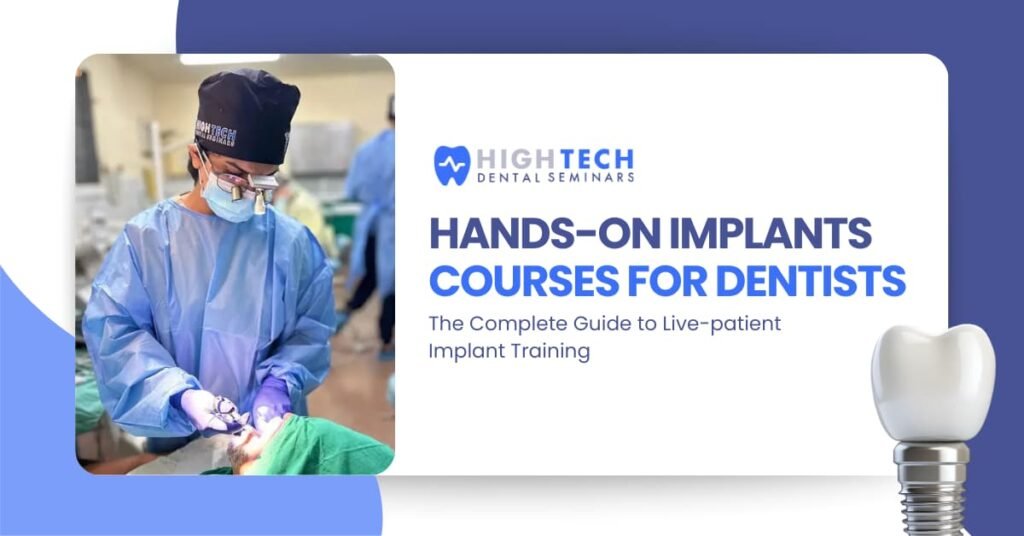
Hands-on implant courses for dentists combine lectures with practical training, so clinicians plan, place and restore implants under supervision rather than only learning the theory. The most complete programs progress from didactic teaching and simulation to supervised live-patient surgery, then mentorship as dentists begin their own cases. Look for clear case numbers, experienced supervision and credit recognition.
Implant dentistry is learned mainly after dental school, through continuing education. This guide from High Tech Dental Seminars (HTDS) explains why hands-on training matters, what hands-on and live patient implant courses include, what a curriculum should cover, how to evaluate programs in Canada and abroad, how dentists move from training to practice, and how our courses are structured.
Why Do Dentists Need Hands-On Implant Training?
Dentists need hands-on implant training because placing implants safely depends on skills that lectures cannot build alone: reading 3D imaging, controlling osteotomy depth and angle, achieving primary stability, handling soft tissue and restoring to a prosthetic plan. Implants perform well when protocols are followed, so the aim of training is consistent, safe execution.
Long-term evidence is strong. A 2019 meta-analysis in the Journal of Dentistry estimated 10-year implant survival at 96.4%, with lower estimates in some groups, such as patients aged 65 and older. Outcomes like these depend on case selection, planning and technique, which is why supervised practice is central to implant education.
In Ontario, implant dentistry is not one of the dental specialties recognized by the RCDSO, and general dentists may place implants. That makes the dentist responsible for obtaining appropriate training and for practising within their competence. Courses describe training; they do not create a specialist title.
What Are Hands-On Implant Courses?
Hands-on implant courses are continuing education programs that teach implant planning, surgery and restoration through direct practice, not just observation. They usually combine three components: didactic teaching on biology and planning, simulation on models or typodonts, and, in comprehensive programs, supervised treatment of real patients.
| Format | What You Do | Strengths | Limits |
| Lecture-only | Learn concepts, watch videos | Efficient theory; low cost | No tactile skill or case judgment |
| Simulation workshops | Drill and place implants in models or synthetic bone | Builds handling and sequence familiarity | Cannot reproduce bleeding, anatomy or patient factors |
| Live-patient programs | Plan and place implants in patients under supervision | Real anatomy, bone density and decision-making | Larger time and cost commitment; quality depends on supervision |
| Multi-module residency | All of the above over months, with mentorship | Progressive skill building; case variety | Requires planning around practice schedules |
Lecture-only courses are useful for understanding biology, implant design and new evidence, and they are a sensible first step. They cannot teach tactile control, how bone of different densities feels during drilling or how to respond when a case changes mid-surgery. Most dentists benefit from a combination: theory and simulation first, then supervised clinical cases. Our dental implant training guide explains how to stage these steps.
What Do Live Patient Implant Courses Add?
Live patient implant courses add the clinical variables that simulation cannot reproduce: differences in bone density, anatomical limits, soft-tissue behaviour, bleeding, patient comfort and real-time decisions when a case does not go as planned. Under close supervision, participants learn to adapt, which builds the judgment needed for independent practice.
A well-run live-patient course should include:
- Case selection and diagnosis before surgery, with CBCT-based planning.
- Supervised osteotomy preparation, placement and suturing.
- Clear supervision ratios and an instructor ready to take over.
- Informed consent from patients who understand they are treated in a training setting.
- Defined follow-up and restorative care for every patient treated.
What Should a Hands-On Implant Curriculum Cover?
A complete hands-on implant curriculum covers the whole workflow, from diagnosis to maintenance, because surgical decisions shape prosthetic outcomes. Placement skills alone are not enough; dentists also need prosthetic planning and complication management.
| Area | Key Topics |
| Diagnosis and planning | Medical history, CBCT interpretation, nerve and sinus anatomy, prosthetic space, occlusion |
| Surgery | Flap design, osteotomy sequence, irrigation, depth and angle control, primary stability, suturing |
| Guided and digital workflows | Surgical guides, digital planning and scanning |
| Prosthetics | Abutment selection, impressions or scans, screw- vs cement-retained restorations, occlusal design |
| Complications | Early failure, peri-implant disease, mechanical problems and when to refer |
| Maintenance | Baseline records, recall planning and supportive peri-implant care |
For more on digital workflows, see our article on whether digital implant planning is worth the investment.
Hands-On Implant Courses at High Tech Dental Seminars
At High Tech Dental Seminars, run by dentists for dentists, our hands-on implant courses follow a staged model: a residency-style program in Ontario for building foundations, and intensive international courses for dentists ready for higher surgical volume. All programs combine lectures, supervised surgery and restorative planning.
| Program | Format | Key Details |
| Step-by-Step Dental Implants Training | 6 modules over 9 months in Ontario | Lectures in Mississauga, surgery in Hamilton; 5 guaranteed implant placements plus 5 assists; no prior implant experience required; 140 Category 2 credits; mentorship after the course |
| Foundational Dental Implant Course, International | Six-day course in Lima, Peru | 30+ implants; 60 CE credits |
| Advanced Dental Implant Course, International | Six-day course in Lima, Peru | 15 implants within advanced cases; 60 CE credits; Foundational course or equivalent required |
| All-on-X Dental Implants Course, International | Six-day course in Lima, Peru | 5 full-arch cases; 60 CE credits; prior implant experience required |
The next international courses run January 24 to 29, 2027. Check each course page for current availability, as some cohorts fill and move to a waitlist.
We are a Nationally Approved PACE Program Provider for FAGD/MAGD credit (Provider ID 394371, July 1, 2025 to June 30, 2028). PACE approval does not imply acceptance by any regulatory authority or AGD endorsement. Credit recognition is decided by your provincial regulator; in Ontario, the RCDSO requires at least 90 CE points in each three-year cycle.
What to Check Before Joining an International Implant Course
International implant courses can offer more surgical cases in a short time, but they need careful checking. Confirm how patients are selected and consented, who supervises, how local licensing for participants is handled, who provides follow-up care, how credits will be recognized at home and what travel advice applies.
- Patient care: Who selects cases, obtains consent and provides restorations and follow-up after you leave?
- Supervision: What is the instructor-to-participant ratio during surgery?
- Legal and licensing arrangements: How does the host institution authorize participants to treat patients?
- Credits: How will your regulator categorize the course?
- Travel safety: Check the Government of Canada’s travel advice for Peru before booking and again before you travel.
- Insurance: Confirm your professional liability position for treatment provided abroad.
Our International Implant Training page explains how our Lima courses are organized.
Simulation or Live Patients: Do You Need Both?
Most dentists benefit from both. Simulation lets you learn the drilling sequence, implant handling and ergonomics without risk, which makes your first supervised patient cases safer and more productive. Live-patient training then adds the judgment that only real anatomy and real patients can teach. Skipping simulation can waste clinical time; skipping live patients can leave a gap in confidence.
What you will need after the course
Before you place implants in your own practice, plan the systems that support safe treatment:
- Imaging: access to CBCT, in-house or through referral, and software to plan cases.
- Surgical setup: a surgical motor, implant kit, sterile protocols and suitable treatment room set-up.
- Restorative pathway: a dental laboratory familiar with your implant system, and impression or scanning components.
- Documentation: consent forms, surgical checklists, implant records and maintenance recall systems.
- Support: a mentor or study group for case review, and a referral network for complex cases.
Questions to ask past participants
If possible, speak with dentists who have completed the course. Ask how many implants they placed themselves, how closely they were supervised, whether the restorative phase was covered properly and whether they now place implants in their own practice. Their answers often reveal more than a brochure.
How to Choose the Right Hands-On Implant Course
Choose a hands-on implant course by matching it to your current experience, then checking case numbers, supervision, curriculum breadth, mentorship, credit recognition and total cost. The right course should leave you able to treat straightforward cases safely, with support available for your first independent placements.
- Experience match: Does the course suit a beginner or assume prior placements?
- Case numbers: How many implants will you place yourself, and how many will you assist?
- Supervision: Who teaches, and how closely are you supervised?
- Curriculum: Does it cover planning, prosthetics and complications, not only surgery?
- Mentorship: Is case review available after the course?
- Recognition: How will your regulator count the credits?
- Total cost: Include travel, time away from practice and equipment you will need.
How Do Dentists Transition to Placing Implants in Practice?
Many dentists transition to placing implants in stages. They start with straightforward single-implant cases with good bone and simple anatomy, use mentorship and case review for their early cases, and add grafting, multiple implants or full-arch work only as experience grows.
- Start simple: adequate bone, single posterior implants, predictable occlusion.
- Keep support: plan early cases with a mentor and review outcomes.
- Build systems: consent forms, imaging protocols, surgical checklists and maintenance recalls.
- Expand carefully: move to advanced procedures through further training, not trial and error.
Many dentists find that restoring implants placed by colleagues, before placing their own, is a useful way to understand prosthetic requirements. Others begin by placing implants alongside a mentor in their own practice. Whatever the route, review each early case and keep complete records. If you are just starting, read whether a dental implant course for beginners is right for you.
Frequently Asked Questions
How long does hands-on implant training take?
It varies by format. Short workshops last a day or two, while comprehensive programs run over several months. Our Step-by-Step Dental Implants Training runs six modules over nine months, and our international courses in Lima are six-day intensive programs.
Can general dentists take hands-on implant courses?
Yes. Most hands-on implant courses are designed for general dentists. In Ontario, implant dentistry is not a recognized specialty and general dentists may place implants, provided they practise within their competence. Choose a course that matches your current experience.
What are live patient implant courses?
Live patient implant courses let participants plan and place implants in real patients under direct instructor supervision. They expose dentists to real anatomy, bone density and clinical decision-making that simulation cannot reproduce. Good programs also explain how patients are consented and followed up.
How many implants should a dentist place during training?
There is no universal number, but more supervised cases generally build more confidence. Ask each provider how many implants you will place yourself versus assist. Our Ontario program guarantees 5 placements plus 5 assists, and our international courses offer higher volumes.
Do hands-on implant courses count for CE credit?
Usually, yes. Recognition depends on your provincial regulator and the provider’s approvals. Our Ontario residency is listed as eligible for 140 Category 2 credits, and our international courses carry 60 CE credits each. Confirm how your regulator will categorize any course before registering.
Start Your Hands-On Implant Training
Hands-on implant courses for dentists turn implant theory into safe, repeatable clinical skill when they combine planning, supervised surgery, prosthetics and mentorship. Choosing the right format for your experience is the first step.
To compare our programs or discuss where to start, explore our courses or book a consultation with our team.