
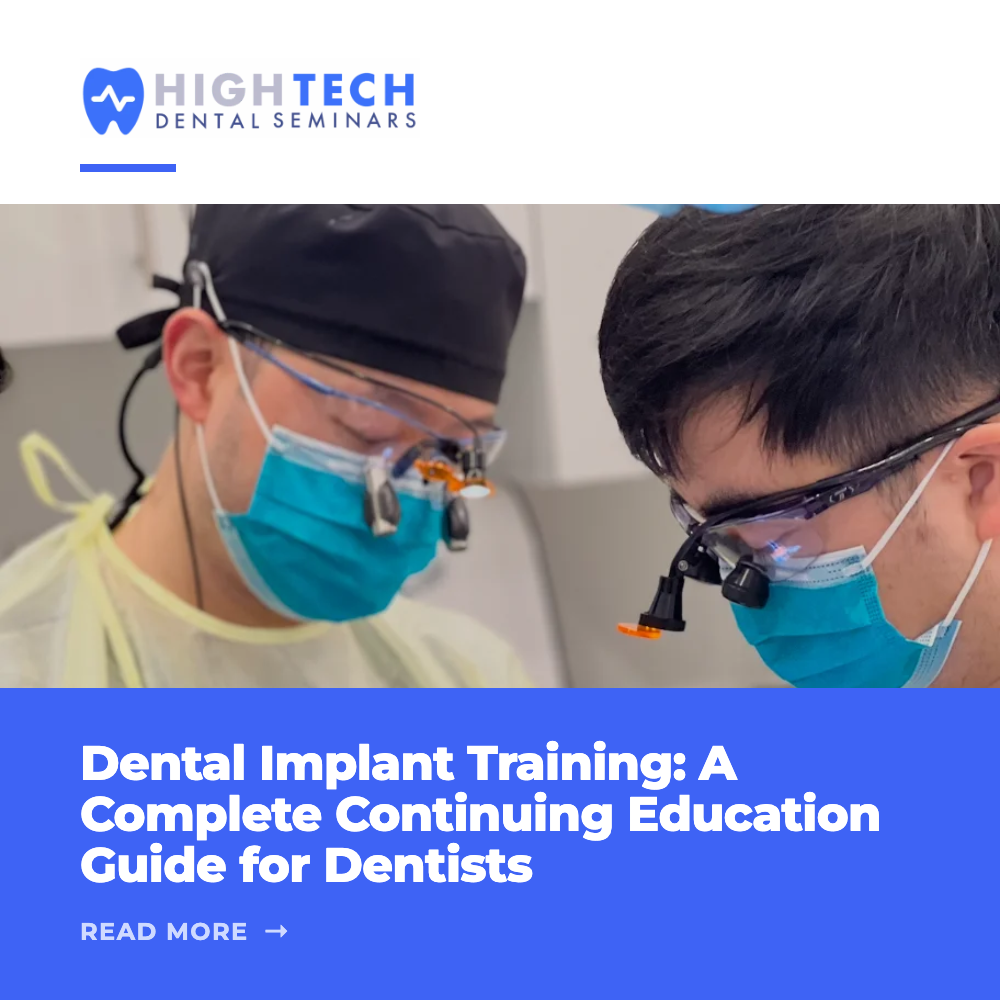
Implant dentistry has become a routine part of general practice for many dentists, but building genuine competence in it takes structured learning rather than a single weekend course. A dental implant training guide is designed to help practising dentists work through exactly that: the knowledge and clinical skills involved in implant dentistry, from the first patient assessment through to long-term maintenance. Implant treatment is rarely a single procedure. It typically moves through several linked stages, including assessment, treatment planning, surgical placement, restoration and ongoing review, and a dentist’s continuing education should ideally reflect that full sequence rather than just one part of it. High Tech Dental Seminars structures its own Canadian program around exactly this kind of sequence, running it as a modular course rather than a single weekend event.
This guide is written for practising dentists who are looking for structured continuing education, practical training or a clearer picture of what implant dentistry education actually involves. Training programs in this space differ considerably in scope. Some focus mainly on treatment planning and foundational concepts, while others build in surgical technique, restorative workflows, digital planning software, case selection frameworks or genuinely hands-on clinical exercises. In plain terms, a dental implant training guide is an educational resource that outlines the knowledge, clinical concepts and practical skills dentists may need to develop when learning about dental implant planning, placement, restoration and maintenance, and it can help a dentist evaluate training options and identify where their own continuing education should focus next.
It is worth being clear from the outset that no guide, article or course on its own qualifies a dentist to perform implant procedures. Continuing education in implant dentistry should complement a dentist’s existing clinical qualifications, the professional requirements of their regulatory body, and supervised clinical experience where that applies.
What Is a Dental Implant Training Guide?
A dental implant training guide is an educational resource that maps out what dentists need to learn to practise implant dentistry safely and competently, and it can support anyone comparing courses or planning their own continuing education. A genuinely useful guide covers the whole implant treatment workflow rather than focusing only on the surgical moment of placing an implant, since placement is only one stage in a longer clinical process.
The major stages a well-rounded guide should address include:
- Patient assessment
- Diagnosis
- Treatment planning
- Case selection
- Surgical planning
- Implant placement
- Healing and follow-up
- Prosthetic restoration
- Maintenance and long-term monitoring
Training in this field ranges from introductory education, aimed at dentists building foundational knowledge, through to advanced clinical programs for those refining surgical or restorative technique. Where a dentist should start depends on their existing background rather than the course with the most impressive title.
Who Should Use a Dental Implant Training Guide?
This kind of guide is useful for dentists at several different stages of professional development, including those:
- Exploring implant dentistry for the first time
- Seeking foundational implant education
- Looking to expand existing implant knowledge
- Interested in surgical implant placement
- Focusing specifically on implant restoration
- Comparing continuing education programs
- Seeking hands-on implant training with live clinical exposure
The right educational pathway for any of these dentists depends on their existing qualifications, clinical experience and professional scope of practice, so the same guide can point two dentists toward quite different next steps.
Key Topics Covered in Dental Implant Training
A well-rounded implant dentistry course should walk through several major subject areas, each building on the last. Understanding what these topics involve makes it easier to judge whether a specific course actually covers the ground a dentist needs.
Patient Assessment and Case Selection
Before any planning begins, training should cover how to judge whether implant treatment is appropriate for a specific patient. That typically involves reviewing:
- Medical and dental history
- Oral health status
- Periodontal health
- Bone availability
- Existing restorations
- Occlusion
- Patient expectations
- Smoking and other relevant risk factors
- Treatment limitations and contraindications
Recognising which cases sit outside a dentist’s current scope, and where a referral or specialist input would serve the patient better, is as much a part of case selection training as identifying which cases are straightforward.
Diagnostic Records and Treatment Planning
Good implant planning depends on good diagnostic information. Training in this area typically covers:
- Clinical examination
- Radiographic assessment
- Three-dimensional imaging when indicated
- Digital impressions or scans
- Study models
- Occlusal analysis
- Aesthetic evaluation
Dentists learn to use this diagnostic information to work out implant position, assess available bone and understand what the eventual restoration will require, so that planning happens with the end result already in mind rather than being decided after the fact.
Surgical Planning
Surgical planning training introduces the principles behind deciding where and how an implant will be placed, including:
- Implant position
- Prosthetically driven planning, where the final restoration guides the surgical plan
- Surgical access
- Bone volume and quality
- Important anatomical structures nearby
- Soft-tissue considerations
- Surgical guides where appropriate
- Risk assessment
Good training links surgical planning directly to the restorative outcome the patient needs, rather than treating the surgical and restorative stages as separate problems. Some programs also compare guided approaches with freehand technique, since the choice between surgical guides and freehand implant placement affects both planning and execution.
Implant Placement Principles
Placement training covers the foundational principles dentists need to understand, including:
- Site preparation
- Implant positioning
- Primary stability
- Surgical technique
- Tissue management
- Protection of anatomical structures
- Infection control
- Postoperative care
Reading about these principles, including a structured overview of the step-by-step dental implant placement protocol, can build understanding, but it is not a substitute for supervised clinical education or formal hands-on training.
Implant Restoration
Successful implant treatment does not end with surgical placement. Restorative topics that training should cover include:
- Abutment selection
- Impression or digital scanning workflows
- Provisional restorations
- Final restorations
- Occlusion
- Aesthetics
- Emergence profile
- Implant-supported crowns, bridges and other prostheses
Clear communication between the surgical and restorative stages, whether that is one dentist managing both or two clinicians coordinating, has a direct effect on how well the final result functions and looks.
Complications and Risk Management
Well-rounded implant education should also cover recognising, preventing and managing complications, including:
- Implant positioning complications
- Infection
- Peri-implant disease
- Prosthetic complications
- Soft-tissue concerns
- Bone loss, which is one reason bone grafting for dental implants is often taught alongside placement technique
- Mechanical complications
- Failed osseointegration
- Maintenance challenges
This part of training works best when it is framed around clinical decision-making and knowing when to manage a problem versus when to refer it on, rather than presented as a single protocol that applies to every complication.
Essential Skills for Dental Implant Placement
Beyond subject knowledge, structured implant education should help dentists build specific practical competencies.
Treatment Planning Skills
Training should help dentists translate diagnostic findings into an individualised implant treatment plan, developing skills in case selection, risk assessment, treatment sequencing, implant positioning, restorative planning and patient communication.
Surgical Skills
Practical implant placement training may address foundational surgical competencies, depending on the program, including surgical planning, flap and soft-tissue considerations, osteotomy principles, implant positioning, primary stability, suturing and tissue management, and awareness of surgical complications. For hands-on courses, practical exercises should always take place within the program’s appropriate educational and clinical setting, under proper supervision.
Restorative Skills
On the restorative side, useful competencies include impression techniques, digital workflows, abutment selection, occlusal considerations, provisionalisation, final restoration planning and troubleshooting prosthetic concerns.
Communication and Case Presentation
Implant education should also strengthen how dentists communicate, covering how to explain treatment options, discuss risks and limitations, set realistic expectations, present alternative treatments, communicate with dental laboratories and coordinate multidisciplinary care when a case needs it.
Hands-On Implant Course vs Online Education
Training formats vary considerably in what they can realistically offer, and it helps to know what each format is generally suited for before comparing specific courses.
| Training Format | Potential Focus | Key Consideration |
| Online course | Theory, treatment planning and foundational knowledge | Limited opportunity for physical hands-on practice |
| Lecture-based CE | Structured concepts and case discussions | Practical experience may vary |
| Hands-on implant course | Practical exercises and technique development | Requires appropriate faculty, facilities and course design |
| Clinical mentorship | Application of knowledge to real-world cases | Availability and supervision structure vary |
| Comprehensive program | Combination of theory, practical and clinical components | Often requires greater time and commitment |
The best format depends on a dentist’s current experience, their specific learning objectives and their scope of practice, rather than on which format sounds the most advanced. High Tech Dental Seminars runs both ends of this spectrum: a modular Canadian program spread across several months, and shorter, intensive international programs concentrated into a single week — worth comparing against your own schedule and learning goals rather than assuming one format suits everyone.
Choosing the Right Dental Implant Training Program
Once a dentist understands what implant training should cover, the next step is comparing actual programs against that standard. This is also where many dentists start weighing up CE courses for dentists more broadly, since an implant-focused program still needs to fit alongside a dentist’s wider continuing education plan.
Course Content and Learning Objectives
Review the curriculum carefully and check that it covers diagnosis, case selection, treatment planning, surgical principles, implant placement, restorative workflows, complication management, maintenance and patient communication. A course should match a dentist’s current level of experience rather than being chosen purely on the strength of its title.
Faculty and Clinical Experience
Educators’ qualifications, clinical experience and teaching approach all affect how much a dentist actually takes away from a course. Worth reviewing before enrolling:
- Faculty backgrounds
- Clinical experience
- Teaching credentials, where relevant
- Course structure
- Faculty-to-participant interaction
- Availability of mentorship or case discussion
High Tech Dental Seminars, for example, lists its Canadian program faculty by name and credential on its own site, including a periodontist who is board-certified in both Canada and the United States — the kind of detail worth looking for and verifying directly with any program you’re considering, since faculty pages can change and any specific credential claim should be confirmed with the organisation running the course rather than taken on faith from marketing material.
Hands-On Training Opportunities
For dentists specifically seeking practical experience, it is worth examining what a hands-on dental implant training program actually means in practice. Useful questions include:
- What procedures or exercises are included?
- What models, simulation systems or clinical settings are used?
- How much practical time is provided?
- How closely are participants supervised?
- Is feedback provided during practical exercises?
- Are participants expected to have prior experience?
Some programs, including High Tech Dental Seminars’ Canadian course, run their hands-on components at a dedicated training facility in partnership with an equipment manufacturer’s academy, alongside a supervising clinic. Where a course involves live-patient placements as part of the hands-on component, it’s worth asking directly how patients are selected, how consent and supervision are handled, and how case outcomes are tracked — questions that matter more than any number of placements a course advertises.
Course Credentials and CE Recognition
It is worth confirming whether a program provides recognised continuing education credits, and what that recognition actually covers. In Ontario, the Royal College of Dental Surgeons of Ontario sets continuing education requirements for licensed dentists, distinguishing between Category 1 courses approved through its Quality Assurance Committee and broader Category 2 activities such as university teaching or peer-reviewed publications. Requirements differ by jurisdiction, so dentists practising outside Ontario should check their own regulator’s rules rather than assuming the same categories apply.
Some implant-focused continuing education also counts toward credentials offered by professional implant organisations. The International Congress of Oral Implantologists’ Fellowship credential, for example, has its own separate requirements around case numbers, hours of implant education and an application process, so a course contributing toward eligibility is not the same as a course automatically granting the credential itself. High Tech Dental Seminars, for instance, is listed as a PACE-approved continuing education provider through the Academy of General Dentistry, which is a useful example of the kind of accreditation detail — provider name, approval period, provider ID — worth asking any program to confirm in writing rather than assuming from a course description.
Course Format, Time and Cost
Practical comparisons worth making between programs include online versus in-person delivery, course duration, number of sessions, hands-on components, faculty access, materials included, travel requirements and course fees. The lowest-cost course is not necessarily the best fit if it does not actually meet a dentist’s learning objectives.
Patient Case Selection and Referral
Continuing education should also help dentists recognise the limits of their own experience. That means understanding when a case may call for additional training, specialist consultation, multidisciplinary planning, referral, or more advanced diagnostic assessment before treatment begins. This kind of judgement is central to patient safety and sound professional practice, regardless of how experienced a dentist becomes.
Continuing Education After Dental Implant Training
Completing a dental implant continuing education program is rarely the end point of professional development in this field. Implant dentistry keeps evolving, and ongoing learning is part of practising it well.
Ongoing Implant Education
Dentists can keep building their knowledge through advanced CE courses, implant study clubs, case-based education, conferences, workshops, peer discussion, professional organisations, academic literature and clinical mentorship. Education that builds progressively on a dentist’s existing knowledge and clinical experience tends to be more useful than jumping straight to advanced topics.
For dentists weighing up whether further training is worth the investment, it can help to think through the return on investment of adding implants to a practice after certification, since ongoing education and practice growth are closely linked.
Reviewing Implant Cases
Structured case review after training has real value. Dentists can look back over their treatment planning decisions, implant positioning, surgical outcomes, restorative results, any complications, and how they communicated with patients throughout, and use that reflection to identify areas for improvement. Reviewing cases this way is a form of reflective learning, not a guarantee that every future case will follow the same pattern.
Keeping Up With Evidence and Technology
Implant dentistry continues to evolve in areas such as digital treatment planning, guided implant surgery, digital impressions, CAD/CAM workflows, new restorative materials, imaging technologies and evidence-based treatment protocols. Emerging tools are genuinely changing parts of the workflow. A recent systematic review of artificial intelligence in implant treatment planning found that AI-assisted analysis of CBCT scans achieved high accuracy in tasks such as identifying anatomical structures, though the authors also noted that current evidence is still limited by small study samples and a lack of large-scale clinical validation. That is a useful reminder to evaluate new techniques against current evidence rather than adopting a technology simply because it is newer.
Building a Long-Term CE Plan
A structured, staged approach to continuing education tends to work better than picking courses at random.
| Stage | Educational Focus |
| Foundational | Implant terminology, diagnosis, anatomy and treatment planning |
| Practical | Surgical and restorative principles with appropriate hands-on learning |
| Clinical Development | Case selection, treatment execution and complication management |
| Advanced | Complex cases, multidisciplinary planning and advanced techniques |
| Ongoing | Evidence review, case analysis and emerging technologies |
Dentists should build their education plan around their actual clinical scope, experience and professional development goals, rather than following a generic sequence that may not match where they are starting from.
Choosing Dental Implant Training in Mississauga
For dentists based in Mississauga or elsewhere in the Greater Toronto Area, proximity to classroom-based instruction can be a practical factor when comparing programs, particularly for courses that combine classroom learning with live clinical sessions at a separate location. High Tech Dental Seminars’ own Canadian program, for instance, runs its clinical components out of Hamilton — close enough for a GTA-based dentist to manage without extensive travel, but still worth checking against your own commuting tolerance across a multi-month, multi-module course. When weighing up options locally, it is worth considering the same fundamentals that apply anywhere: course curriculum, practical training opportunities, faculty expertise, CE recognition, course format, case-based learning, mentorship opportunities, and how closely the program integrates treatment planning with restorative and surgical stages.
Ontario dentists exploring continuing education for dentists have a range of implant dentistry course and hands-on implant course formats to compare, from shorter international programs to longer Canadian courses that combine classroom sessions with live patient placements. As with any program, the right fit depends on a dentist’s current experience, learning goals and scope of practice rather than location alone, but for dentists who want to minimise travel for classroom components specifically, confirming exactly where each part of a course takes place is a reasonable question to ask before enrolling.
Dental Implant Training Cost Considerations
The cost of dental implant training can vary substantially depending on course format, duration, faculty, hands-on components and the educational resources provided. Factors that influence price include:
- Online versus in-person format
- Number of training days
- Hands-on components
- Faculty access
- Simulation materials
- Clinical components
- CE accreditation
- Course materials
- Travel and accommodation
- Advanced equipment or technology used during training
Course prices change over time and vary by provider, so this guide does not quote specific figures. For a closer look at how implant CE pricing tends to break down in Canada, this overview of dental implant CE course costs walks through the main cost drivers in more detail. In general, it is worth comparing the total educational value and relevance of a program to a dentist’s own goals, rather than choosing based on price alone.
Dental implant training gives practising dentists a structured way to build the knowledge and clinical skills implant dentistry requires, from the first patient assessment through to long-term maintenance. Whether a dentist is exploring implant dentistry for the first time or looking to extend existing skills, the right training aligns theory, practical learning, evidence-based content and a clear path for ongoing professional development, rather than treating a single course as a finish line. Completing one program does not, on its own, qualify a dentist to independently perform advanced implant procedures; it is one stage in an ongoing process of clinical development. Dentists ready to compare options can look into the available courses and consider which program best matches their current experience and professional goals.
Explore Implant Training Programs
Frequently Asked Questions
What should a dental implant training guide include?
A well-rounded dental implant training guide should cover the full implant treatment workflow, from patient assessment and case selection through treatment planning, placement, restoration, maintenance and complication management. It should also address practical training considerations, such as how much hands-on experience a course offers, and point dentists toward relevant continuing education so the guide functions as a planning tool rather than a one-off read.
Who should use a dental implant training guide?
The guide can be useful for dentists exploring implant dentistry for the first time, those developing foundational knowledge, dentists comparing different implant dentistry courses, and clinicians planning their ongoing professional education. The appropriate training level always depends on the individual dentist’s qualifications, clinical experience and current scope of practice, so the same guide can point different readers toward quite different next steps.
What skills can dentists develop through dental implant training?
Dentists can develop skills across case selection, diagnosis, treatment planning, surgical planning, implant placement principles, restorative workflows, complication recognition, patient communication and multidisciplinary treatment planning. Exactly which skills a given course builds depends on its curriculum, format and how much hands-on or supervised clinical training it actually includes, so it is worth checking this against a dentist’s specific goals before enrolling.
How can a dental implant training guide support continuing education?
A guide can help dentists identify gaps in their current knowledge, understand the full implant treatment workflow, and compare different dental implant continuing education opportunities on a consistent basis. It works best as an educational planning resource that shapes what to look for in a course, rather than as a replacement for formal training or supervised clinical experience.
What should dentists consider when choosing implant training?
Dentists should review the curriculum, faculty experience, course level, hands-on opportunities, clinical or simulation experience, CE recognition, course format, mentorship availability, cost and overall relevance to their professional goals. It is also worth verifying a course’s credentials, its specific educational claims and its CE eligibility directly with the provider before enrolling, rather than assuming these details from marketing material alone.