
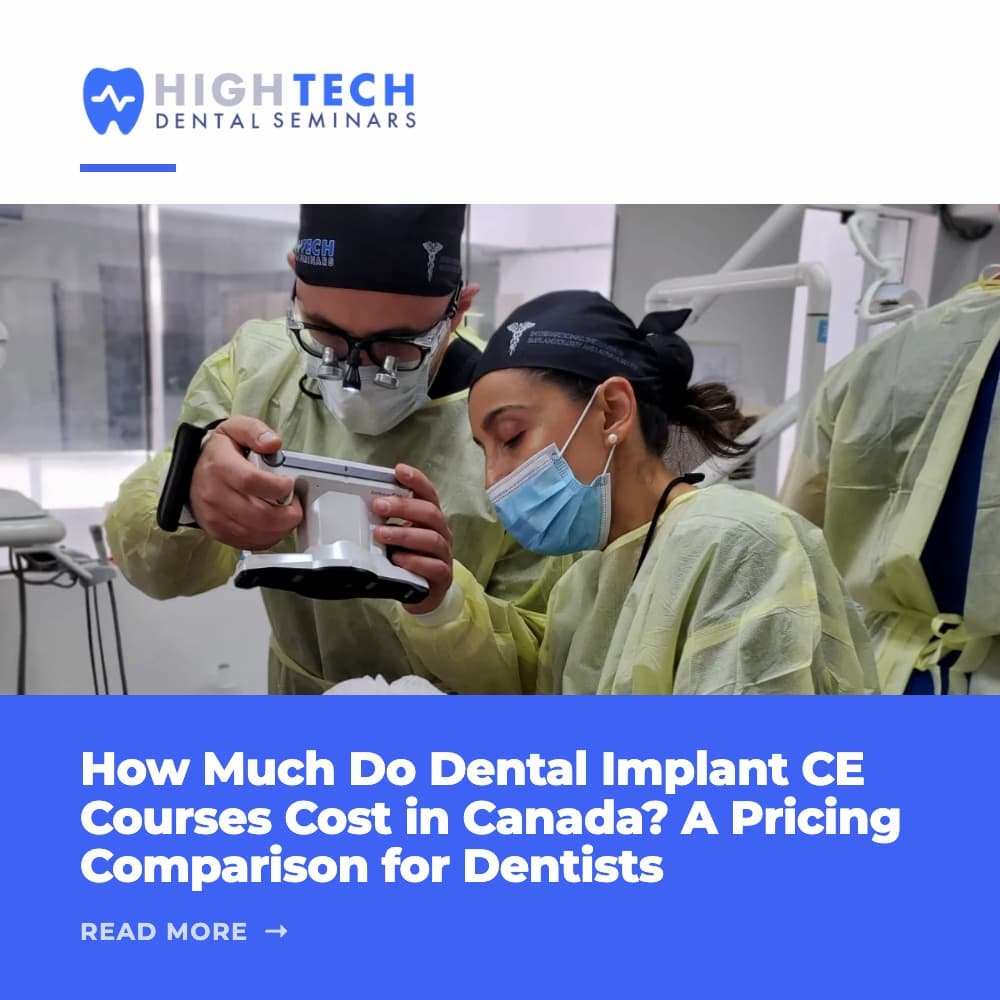
Expanding your general dental practice to include surgical implant placement is one of the most powerful professional and financial milestones in a clinician’s career. However, evaluating continuing education requires navigating a wide spectrum of tuition fees, course formats, simulation platforms, advanced grafting add-ons, and hidden operational expenses. Understanding the true dental implant CE course cost helps Canadian dentists budget effectively and select programs that deliver genuine clinical competency.
At High Tech Dental Seminars, we believe in transparent, comprehensive education designed to provide exceptional clinical value without unexpected financial surprises.
This comprehensive guide breaks down continuing education fees across course tiers, evaluates hands-on simulation platforms, analyzes advanced bone grafting and sinus lift modules, reviews regional tuition variances across Canadian provinces, examines hidden travel and opportunity costs, explores tuition inclusions like surgical kits, reviews third-party financing solutions, outlines capital expenditure budgeting, details study club commitments, highlights business tax deductions, and connects educational investments directly to practice payback timelines.
Dental Implant CE Course Cost: What Is the Financial Investment in Canada?
Direct Answer: Dental implant continuing education course costs in Canada typically range from $2,500 for foundational didactic lecture modules to $15,000 or $19,895+ for comprehensive live-patient surgical residencies. Total financial investment depends on curriculum depth, hands-on cadaver or live-patient hours, faculty credentials, and whether surgical instruments are included.
In Canada, dental implant continuing education course costs typically range from $2,500 for foundational lecture-based modules to $15,000+ for comprehensive live-patient surgical residencies. The total financial investment depends heavily on the curriculum depth, hands-on cadaver or live-patient hours, instructor credentials, simulation technology utilized, and whether specialized surgical instruments are included in the tuition.
Summary of Implant CE Course Cost Tiers
Course Format Tier | Typical Tuition Range (CAD) | Curriculum Focus & Hands-On Depth | Primary Target Audience |
Introductory Didactic Courses | $2,500 to $5,000 | Lecture-based theory, diagnosis, case selection, basic treatment planning | Dentists beginning their implant education journey |
Intermediate Hands-On Workshops | $5,000 to $10,000 | Typodont simulation, flap design, osteotomy drilling, basic suturing | Clinicians ready for tactile benchtop practice |
Advanced Live-Patient Residencies | $10,000 to $20,000+ | Live-patient surgical placement, cadaver labs, mentorship, complex grafting | Dentists seeking immediate in-house surgical proficiency |
Tiered Breakdown of Dental Implant Continuing Education Fees
Implant training is not a one-size-fits-all offering. Educational providers structure their programs across distinct tiers that reflect varying levels of clinical immersion and tactile experience.
1. Introductory Didactic and Theory Modules
Foundational courses focus primarily on diagnostic criteria, anatomical evaluation, prosthetic design, and radiographic CBCT interpretation. These lecture-focused programs generally require lower tuition investments but provide only conceptual understanding without practical surgical simulation.
2. Intermediate Benchtop and Typodont Workshops
Mid-tier programs introduce hands-on simulation using synthetic jaw models (typodonts). Dentists practice incision designs, mucoperiosteal flap elevation, sequential osteotomy drilling, and knot tying. Tuition reflects the cost of consumable materials, specialized model kits, and specialized facility rentals.
3. Comprehensive Live-Patient Surgical Residencies
The most immersive and impactful programs incorporate live-patient surgical mentoring and cadaver dissection labs. These extensive residencies involve high faculty-to-student ratios, direct supervision during actual patient surgeries, and comprehensive prosthetic loading protocols. While representing a higher upfront tuition commitment, residencies eliminate the steep self-taught learning curve.
Comparing Hands-On Simulation Platforms: Typodonts, Cadaver Labs, and Virtual Reality
The quality of tactile simulation during continuing education directly dictates how confidently a clinician transitions to live-patient surgery. Understanding the strengths of different simulation platforms helps dentists choose the right training environment.
Synthetic Typodont Models
Typodont models offer a clean, standardized environment for practicing basic drill sequencing, angle control, and handpiece ergonomics. While excellent for initial motor skill development, synthetic plastic lacks the true biological resistance, bone density variations, and bleeding management of human tissue.
Human Cadaver Dissection Labs
Cadaver dissection labs provide unmatched anatomical realism. Working on preserved human specimens allows clinicians to navigate true anatomical fascial planes, identify mental and inferior alveolar nerve pathways, and experience authentic cortical and cancellous bone density variations.
Virtual Reality and Haptic Simulators
Emerging training models incorporate haptic-feedback virtual reality to simulate osteotomy drilling in real time. While valuable for visualizing 3D spatial orientation, VR cannot fully replicate the tactile nuance of soft tissue handling and suture tension control.
Simulation Platform Comparison Matrix
Simulation Platform | Tactile Realism | Anatomical Accuracy | Cost Impact on Tuition |
Synthetic Typodonts | Moderate | Standardized / Generic | Lower course tuition fees |
Cadaver Dissection Labs | Exceptional | True human anatomical variation | Higher tuition covering specimen overhead |
Haptic Virtual Reality | High visual fidelity | Digitally rendered models | Specialized tech surcharge |
Advanced Surgical Training: Bone Grafting and Sinus Lift CE Costs
While placing straightforward single-unit implants in pristine bone is an excellent starting point, many patient cases present with localized ridge resorption, requiring auxiliary hard tissue augmentation. Consequently, clinicians frequently evaluate the supplementary cost of advanced bone grafting and sinus lift continuing education modules.
Socket Preservation and Minor Grafting Modules
Introductory grafting courses focus on immediate post-extraction socket preservation using xenografts or allografts combined with collagen membranes and resorbable sutures. These focused weekend workshops typically add $1,500 to $3,000 to a clinician’s ongoing educational expenditure.
Advanced Sinus Augmentation and Block Grafting
Managing severely atrophic posterior maxillae or deficient mandibular ridges requires mastering lateral window sinus lifts, crestal osteotome approaches, and autogenous block grafting. Comprehensive advanced surgical modules covering these complex procedures range from $3,500 to $7,000 in standalone tuition or are integrated into premium live-patient surgical residencies.
Regional Cost Variations Across Canadian Provinces
When planning continuing education investments, Canadian dentists must account for regional pricing variances influenced by local facility overhead, travel logistics, and provincial regulatory hosting requirements.
Ontario and Eastern Canada Hubs
As major metropolitan healthcare centers, Toronto and surrounding Ontario regions host numerous high-density educational seminars. While tuition pricing is competitive due to provider volume, practitioners traveling from outside the Greater Toronto Area must factor in domestic travel expenses.
Western Canada and British Columbia Seminars
Western Canadian programs often incorporate localized clinical residency components in partnership with regional surgical centers. Travel logistics for practitioners based in Alberta, Saskatchewan, or Manitoba can influence total out-of-pocket continuing education budgets.
Hidden Expenses: Travel, Lodging, and Lost Clinical Production
When budgeting for continuing education, looking exclusively at the advertised registration fee paints an incomplete financial picture. Practicing dentists must account for secondary operational expenses.
Travel and Accommodation Outlays
Many premier surgical training residencies are hosted at centralized clinical training facilities or academic centers. Factoring in flights, hotel accommodations, and ground transportation is essential, particularly for multi-module programs spanning several months.
The Opportunity Cost of Clinic Closure
Stepping away from your practice to attend multi-day continuing education courses means pausing daily operatory production. Quantifying your daily production average helps you calculate the true economic impact of time spent away from patient care.
What Is Included in Course Tuition? Evaluating Kits and Materials
Not all continuing education invoices are structured equally. When comparing course costs, it is critical to verify what physical items and support services are bundled into the registration fee.
Surgical Kits and Handpiece Access
Some comprehensive programs include a starter surgical handpiece, torque wrench, or basic osteotomy drill kit as part of your tuition, allowing you to return to your clinic fully equipped to begin placing fixtures. Other programs require you to purchase proprietary surgical hardware separately.
Post-Course Mentorship and Case Review
Valuable continuing education extends beyond the classroom walls. Premium courses often bundle ongoing case mentorship, allowing you to submit your first live patient treatment plans for expert faculty review before touching a drill in your own clinic.
Financing Pathways and Payment Plans for Dental CE Programs
Managing the upfront cash flow impact of premium continuing education requires flexible financial structuring.
Third-Party Medical Professional Financing
Many Canadian financial institutions and specialized healthcare lending groups offer professional development loans specifically tailored for dentists and medical specialists. These programs feature competitive interest rates and extended repayment amortization schedules.
Phased Modular Payment Structures
At High Tech Dental Seminars, we understand the importance of cash flow management. Many of our comprehensive training pathways allow practitioners to pay tuition in structured installments aligned with individual module progression, distributing the financial commitment smoothly across the training calendar.
Structuring Practice Capital Expenditure Budgets for In-House Surgery
Transitioning a general dental practice into an in-house surgical center requires aligning continuing education tuition with overall capital expenditure (CapEx) budgeting.
Balancing Tuition with Equipment Outlays
Smart practice owners budget for continuing education and hardware acquisitions simultaneously. Allocating capital funds for both tuition and basic surgical handpieces ensures that staff and clinicians are trained on the exact equipment they will use chairside.
Phased Integration Budgets
Rather than attempting to purchase every advanced surgical accessory immediately, practices often adopt a phased CapEx approach: funding foundational implant training and starter kits in Year One, followed by 3D CBCT or advanced bone grafting instrumentation in subsequent growth cycles.
The Value of Continuing Study Clubs and Peer Mentorship Networks
Continuing education does not end upon graduation from a surgical residency. Maintaining clinical growth often involves participating in ongoing peer study clubs and advanced clinical mentorship networks.
Collaborative Case Presentation and Review
Study clubs provide a structured forum where general dentists can present complex diagnostic scans, discuss challenging prosthetic bite schemes, and review treatment complications with experienced surgical specialists and peers in a collaborative, non-judgmental environment.
Staying Current with Technological Evolution
Because digital implant planning software, guided surgery templates, and biomaterial science evolve rapidly, ongoing study club membership ensures your practice remains at the cutting edge of modern restorative dentistry.
Tax Deductibility and Business Expense Accounting for Canadian Dentists
For Canadian incorporated dental practices and sole proprietors, investing in continuing education is treated as a legitimate business operating expense.
Professional Development Deductions
According to the Canada Revenue Agency (CRA), continuing education courses that maintain or upgrade professional skills directly related to your dental practice are generally tax-deductible. This includes tuition fees, professional travel expenses, accommodation, and meals associated with attending accredited CE courses, aligning with educational standards supported by the Canadian Dental Association. Consulting your corporate accountant ensures proper corporate tax categorization and maximizes net savings.
Evaluating Course Value Versus Price: Key Quality Indicators
When evaluating whether a dental implant CE course is worth its tuition cost, focus on quality indicators rather than searching for the cheapest available option.
Faculty Experience and Credentials
Courses led by board-certified periodontists, oral and maxillofacial surgeons, or experienced general dentists with verified thousands-of-implants track records provide profound clinical insights that theoretical instructors cannot replicate.
Student-to-Instructor Ratios During Live Surgery
Avoid large-auditorium courses where hands-on supervision is minimal. Look for intimate cohorts with low student-to-instructor ratios, ensuring personalized guidance during live-patient surgical milestones, following safety guidelines established by the Royal College of Dental Surgeons of Ontario.
Calculating the Payback Period: How Fast Do Implant CE Courses Pay Off?
Connecting educational expenses directly to practice revenue models clarifies why advanced surgical training represents an exceptional financial investment.
Break-Even Analysis
Suppose a comprehensive surgical residency tuition and starter kit investment totals $12,000. In a typical Canadian general dental practice, a standard single-tooth implant (including fixture, abutment, and crown) generates between $4,000 and $6,000 in comprehensive fees. Successfully placing and restoring just three to four single-unit cases fully recovers your entire educational investment.
Long-Term Production Multipliers
Once your baseline tuition is recovered, every subsequent implant case executed in-house contributes directly to your clinic’s ongoing profitability, transforming a one-time continuing education cost into a permanent revenue expansion.
Frequently Asked Questions
Are dental implant CE course fees tax-deductible in Canada?
Yes. Continuing education courses that maintain or enhance your professional dental skills are generally tax-deductible as professional development expenses under CRA guidelines for incorporated practices and sole proprietors.
Do I need to buy my own surgical kit before attending a CE course?
Most reputable hands-on courses provide all necessary surgical motors, drill kits, and consumables during the workshop. However, checking course syllabi in advance ensures you know whether you need to bring personal loupes or headlamps.
What is the average duration of a comprehensive implant residency?
Comprehensive live-patient surgical residencies typically span between 4 and 12 months, broken down into multiple modules that combine online lectures, benchtop simulation weekends, and live surgical days.
Can I finance my dental implant training tuition?
Yes. Many specialized healthcare financing institutions and course providers offer flexible monthly payment plans and professional development loans to assist clinicians with tuition management.
How do I know if an implant CE course meets provincial regulatory requirements?
Ensure the course is accredited by recognized dental organizations, such as provincial dental colleges or national dental associations, ensuring your completed hours count toward mandatory CE license renewal cycles.
Take the Next Step in Your Professional Development
Investing in accredited surgical education is the most direct pathway to elevating your clinical capabilities, expanding your practice revenue, and delivering comprehensive care to your patients.
To explore upcoming course dates, transparent tuition breakdowns, and curriculum details, visit our primary dental implant course cost page or connect with our academic team at High Tech Dental Seminars today.