
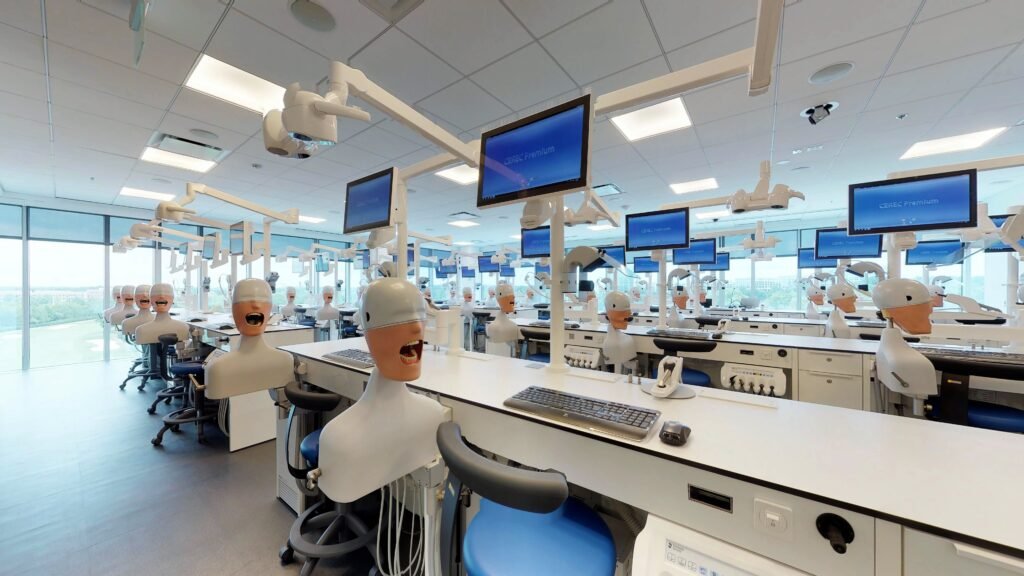
Dental implant training in Peru with High Tech Dental Seminars (HTDS) is a six-day live-patient course in Lima, held in collaboration with the Colegio Odontológico de Lima in Miraflores. The next courses run January 24 to 29, 2027, at three levels: Foundational, Advanced and All-on-X. Each course carries 60 CE credits, with supervised surgery on live patients.
This guide is for Canadian dentists weighing an international course. It explains how the three courses compare, how the week is structured, what is included, what to budget for, what to check as a Canadian practitioner and how to choose the right level. For registration and full course details, see our International Implant Training page.
What Is Dental Implant Training in Peru?
Dental implant training in Peru is an intensive continuing education format in which dentists travel to Lima to place implants on patients under faculty supervision. Our courses combine a day of lectures with five surgical days, so participants can complete many more supervised procedures in one week than a typical domestic weekend course allows.
The courses take place at the Colegio Odontológico de Lima, the professional dental institution for the Lima region, in the Miraflores district. Cases are treatment planned before surgery, and our instructors supervise each procedure. You can read about the team on our instructors page.
Why Do Dentists Choose International Implant CE Courses?
Dentists choose international implant CE courses mainly for surgical volume. A concentrated week of supervised surgery lets participants place more implants, see more bone types and repeat the workflow more often than is usually possible in a domestic course. Time away from practice also allows full focus on learning.
International courses are not for everyone. They require travel, time away from your practice and family, and comfort with working in another country’s clinical setting. Some dentists prefer to learn closer to home over several months, which lets them treat their own patients between modules. HTDS offers both routes: the international courses and our Ontario-based Step-by-Step Dental Implants Training.
How Do the Three Peru Courses Compare?
The three Peru courses differ by experience level and case type. Foundational focuses on single-implant placement and volume, Advanced adds sinus lifts, ridge splits, bone augmentation and immediate placement, and All-on-X focuses on full-arch rehabilitation. All three run January 24 to 29, 2027, in Lima and carry 60 CE credits.
Foundational | Advanced | All-on-X | |
Who it suits | Dentists new to implants or with limited placement experience | Dentists who have completed the Foundational course or an equivalent course | Experienced implant clinicians moving into full arch |
Surgical volume | 30+ implants | 15 implants within advanced cases | 5 full-arch surgeries |
Main focus | Planning, standard placement, varied bone types | Sinus lifts, immediate placement, ridge splitting, bone augmentation | Full-arch planning, multi-unit abutments, immediate loading |
Tuition (USD) | $13,900 | $14,900 | $15,900 |
Course page |
At the time of writing, the January 2027 Foundational course is open for registration, while the Advanced and All-on-X cohorts are full and taking waitlist requests. Check each course page for current availability.
Foundational Dental Implant Course
The Foundational course builds core skills: assessment and CBCT-based planning, patient selection and consent, the surgical sequence from incision to closure, placement in different bone densities, complication prevention and the prosthetic considerations that guide placement. Its main value is repetition, with more than 30 placements and one-on-one supervision on every case. Working across many cases in one week exposes you to different bone densities, ridge shapes and soft tissue types, and lets instructors correct technique before habits form.
Advanced Dental Implant Course
The Advanced course is for dentists who already place straightforward implants. It requires completion of our Foundational course or an equivalent implant course with documentation. Alongside 15 live-patient implant placements, the course covers direct sinus lifts with or without simultaneous placement, immediate placement in extraction sockets, ridge splitting and bone expansion, bone augmentation and the post-operative management of grafted sites. It suits dentists who are comfortable with standard placement and now want to keep more of the cases they currently refer. If you also plan to use surgical guides, our article on whether digital implant planning is worth the investment is useful preparation.
All-on-X Dental Implants Course
The All-on-X course focuses on full-arch rehabilitation, with five complete full-arch cases on live patients. Topics include surgical extractions and site preparation, implant positioning, managing bone quality and primary stability, multi-unit abutments, immediate loading protocols and complication risk management. It is designed for clinicians who already have implant experience. Because full-arch cases combine surgery, prosthetics and immediate loading in one day, participants benefit from arriving with experience in multiple implant placement and basic grafting. Read whether an All-on-X course is right for you before you apply.
How Is a Training Week in Lima Structured?
A training week in Lima runs for six days: one day of lectures and treatment planning, followed by five days of supervised surgery. Each surgical day follows the same pattern of case review, surgery under supervision and post-operative assessment, so skills are repeated and refined across the week.
Day | Focus |
Day 1 | Lectures, protocols, case review and treatment planning |
Days 2 to 6 | Supervised surgery on planned cases, with daily case review and post-operative checks |
Days are long, and surgery schedules depend on each patient’s plan, so expect some variation from day to day. Instruction is in English. Arrangements for patient follow-up after the course should be confirmed with our team when you register.
What Is Included and What Should You Budget For?
Course fees include clinical training, supervised patient treatment, patients, implants, surgical kits and materials, 60 CE credits and a certificate of completion. Accommodation at a five-star hotel in Miraflores, meals and local transportation in Lima are also included. You should budget separately for flights, travel insurance and time away from your practice.
Included:
- Lectures and supervised surgical training.
- Patients, implants, surgical kits and materials.
- A certificate of completion.
- 60 CE credits.
- Five-star hotel accommodation in Miraflores, meals and local transportation in Lima.
Budget separately:
- Return flights to Lima.
- Travel and medical insurance.
- Lost production while away from your practice.
- Any personal travel before or after the course.
Flexible payment plans are available; contact our team for deposit and payment terms. Partners are welcome to share your room and join group activities outside course hours.
How Should You Prepare Before You Fly to Lima?
Preparing well before the course helps you get more from each surgical day. Review implant fundamentals, refresh your knowledge of the implant system and protocols used on the course, and arrange cover for your practice. Arrive rested, because surgical days are long and demanding.
- Review the basics. Revisit bone biology, CBCT anatomy, drilling sequences and suturing.
- Know your goals. Write down the procedures you most want to practise so instructors can help you focus.
- Plan your practice cover. Arrange coverage for emergencies and reschedule patients well in advance.
- Pack sensibly. Bring comfortable clinical footwear, your loupes if you use them, and copies of your licence and certificates.
- Travel early. Arriving a day ahead allows for flight delays and helps you start rested.
What Should Canadian Dentists Check Before Training Abroad?
Before training abroad, Canadian dentists should confirm how their regulator will recognize the CE credits, check their professional liability coverage for activities outside Canada, read the Government of Canada travel advice for Peru and make sure their passport and travel documents are in order. A short checklist avoids surprises later.
- CE recognition. In Ontario, the RCDSO requires at least 90 CE points in each three-year cycle. Ask how credits from an international course will be categorized under your regulator’s rules.
- Liability coverage. Ask your professional liability provider whether supervised treatment during an international course is covered, and what the course provides.
- Travel advice. The Government of Canada advises travellers to exercise a high degree of caution in Peru, with regional advisories for some areas. It also notes a rise in violent crime in the Province of Lima and states of emergency in Lima and Callao. Read the current advice before you book and again before you travel, and register with the Registration of Canadians Abroad service.
- Documents. Check that your passport is valid well beyond your travel dates and review entry requirements on the same travel.gc.ca page.
- Back home. Plan your first implant cases for the weeks after you return, so new skills are used while they are fresh.
What Happens After the Course?
After the course, the goal is to apply your new skills in your own practice. Our lead instructor provides ongoing post-course mentorship to every graduate, so you can discuss plans for your first cases. Start with straightforward cases that match what you practised, and keep detailed records.
Many dentists find it helpful to schedule a few suitable patients for the weeks after they return, review each CBCT plan carefully and build up gradually. If you completed the Foundational course, the Advanced course is a natural next step once simple cases are routine.
Which Peru Course Is Right for You?
Choose the Peru course that matches what you already do. If you have placed few or no implants, start with Foundational. If you place straightforward implants and refer grafting or immediate cases, choose Advanced. If you are experienced and want to provide full-arch care, choose All-on-X.
Your Current Situation | Suggested Course |
New to implants or placed only a handful | Foundational |
Comfortable with single implants in healed sites | Advanced |
Referring sinus lifts, ridge splits or immediate cases | Advanced |
Experienced with grafting and multiple implants, planning full-arch care | All-on-X |
Prefer to learn over months close to home | Ontario Step-by-Step Dental Implants Training |
If you sit between two levels, choose the lower one. Extra repetition at a level you can manage builds more confidence than struggling with cases beyond your experience, and our team can review your case history with you before you decide. Many dentists progress through the levels over time. Our dental implant training guide explains how skills usually build from one stage to the next.
Frequently Asked Questions
When is the next dental implant training in Peru?
The next HTDS courses in Lima run January 24 to 29, 2027, in collaboration with the Colegio Odontológico de Lima in Miraflores. All three levels, Foundational, Advanced and All-on-X, run on the same dates. Check the course pages for availability, waitlists and future dates.
Is it safe to travel to Lima for an implant course?
The Government of Canada currently advises travellers to exercise a high degree of caution in Peru because of crime and social unrest, and it reports states of emergency in Lima and Callao related to violent crime. Read the latest advice on travel.gc.ca before you book and before you go, and follow the logistics and local guidance provided during the course.
Do I need to speak Spanish?
No. Instruction is in English, and our team supports participants throughout the week. Knowing some Spanish can help with daily life in Lima, but it is not required for the course.
Will the CE credits count toward my licence in Canada?
Each course carries 60 CE credits, but recognition is decided by your provincial regulator, not by the course provider. In Ontario, ask how the RCDSO will categorize the activity within your three-year cycle. Keep your certificate and course outline for your records.
Can I bring my partner?
Yes. Partners are welcome to share your room and join group activities outside course hours. Contact our team when you register so we can explain what is included for partners and help with arrangements.
Reserve Your Place in Lima
Dental implant training in Peru offers a concentrated week of supervised surgery at a level that suits your experience, from first placements to full-arch cases. Check your CE recognition, liability coverage and travel plans, then choose the course that matches where you are now.
To reserve a seat, join a waitlist or ask which level fits you, visit our International Implant Training page or book a consultation with our team.