
Introduction
Most dentists considering aligner CE already understand what clear aligners are. The question that a course registration actually needs to answer is different: will three days of training leave me able to treat patients independently, or will I leave with better theoretical grounding and the same uncertainty about starting cases?
The answer depends almost entirely on what those three days cover and how they are structured. This article breaks down the curriculum of a hands-on clear aligner course — what the dentist track addresses, why training the clinical team separately matters, and where the honest scope boundary sits for a GP completing a foundational course.
Why Hands-On Format Produces Different Outcomes Than Lecture-Based Training
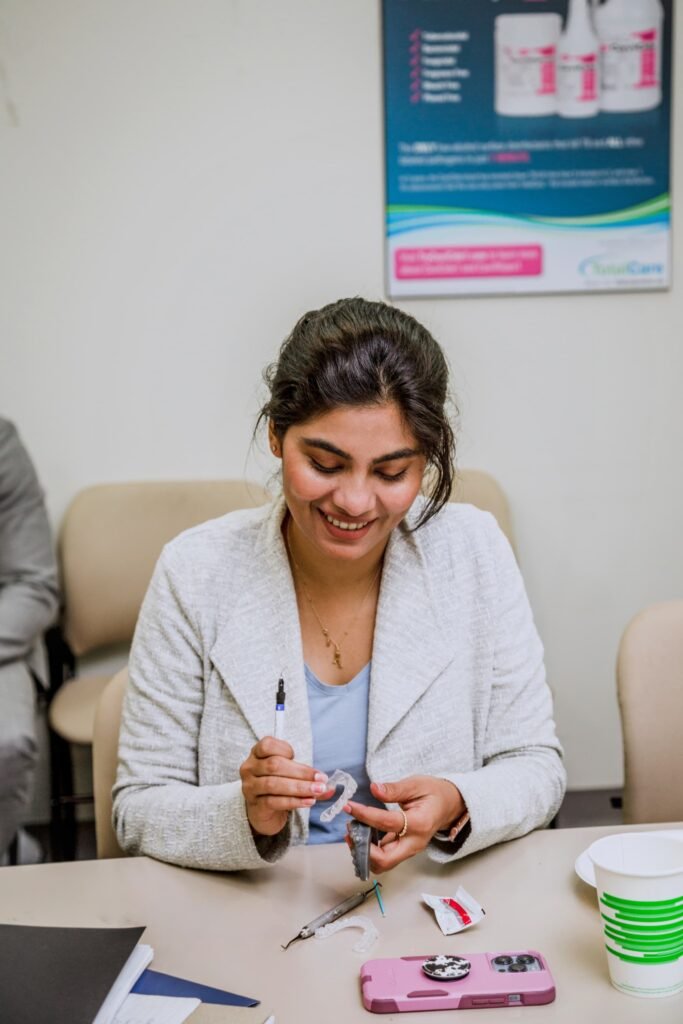
The limitation of lecture-based aligner training is not that it fails to convey information. It is that the clinical skills required to treat aligner patients well — attachment placement, IPR technique, case monitoring judgment, impression quality — are procedural competencies that cannot be developed through information alone.
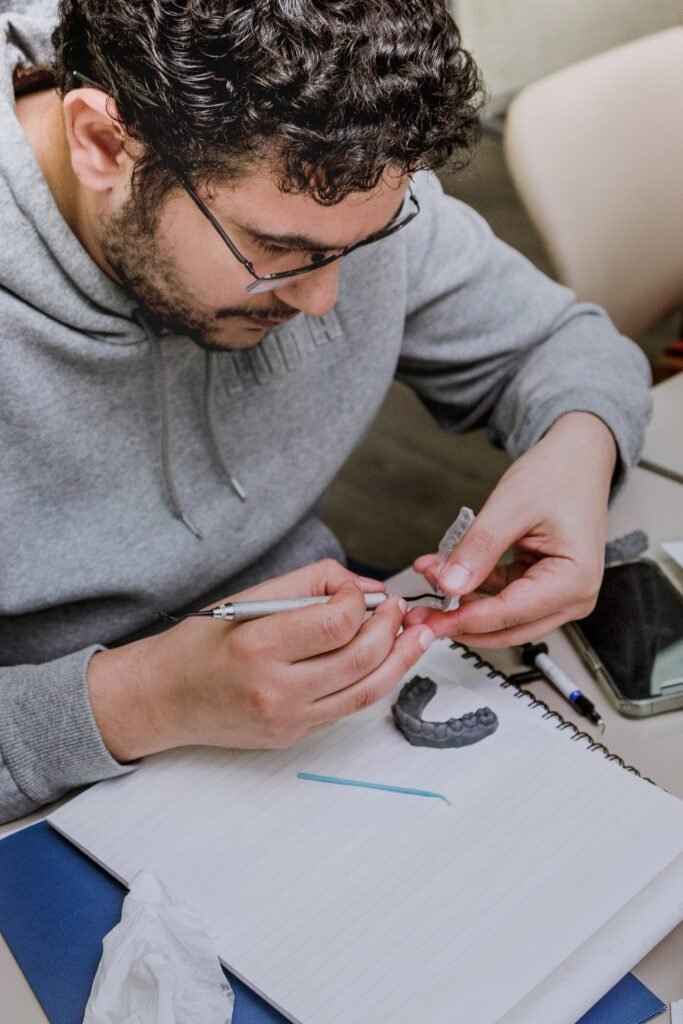
Attachment placement is the most direct example. The bonding sequence, composite dispensing control, template seating, and curing protocol each require tactile repetition to execute consistently. A dentist who has placed attachments on live patients under supervision approaches their first independent case with meaningfully different readiness than one who has watched a demonstration.
The same applies to IPR. The strip selection, angulation, pressure control, and interproximal assessment required for accurate reduction are skills that develop through practice — not through understanding the rationale for interproximal reduction as a biomechanical concept.
Hands-on CE in clear aligner training does not replace clinical experience built over time. It compresses the early learning curve by providing supervised procedural repetition before the dentist encounters it independently.
The Dentist Track: What the Clinical Curriculum Covers
A well-structured hands-on aligner course for dentists should cover the full clinical pathway from case selection through treatment monitoring — not just the placement mechanics. The HTDS Step-by-Step Clear Aligners Course addresses the following across the three-day programme:
Assessment and Case Selection
Orthodontic cephalometric analysis, TMJ examination, case selection criteria for mild to moderate presentations, and the diagnostic record requirements set by RCDSO for aligner treatment in Ontario. Case selection is the competency that determines whether early independent cases go smoothly — selecting appropriate complexity at the outset is a clinical judgment skill, not a software function.
Biomechanics and Treatment Planning
The biomechanics of clear aligner tooth movement, types of orthodontic movement achievable with aligners, and the principles governing how movement is staged and sequenced. Reading ClinCheck — understanding what the software is proposing and why, and where to push back or modify — is covered as a clinical skill, not a software orientation.
Clinical Execution
IPR technique, types of attachments and their biomechanical rationale, attachment placement workshop on live patients, and the full clear aligner placement workflow. Mastering both Invisalign and SureSmile software is included — the course is not tied to a single manufacturer ecosystem.
Documentation and Compliance
Writing a clear aligner prescription, orthodontic record-keeping requirements, and RCDSO compliance documentation specific to aligner treatment. These administrative competencies are consistently underemphasized in CE programs and consistently flagged as gaps when dentists begin independent practice.
Practice Integration
Clear aligners and overall growth in practice production. The course addresses how aligner services integrate into an existing practice model — not as a separate revenue stream but as a clinical capability that changes what the practice can offer and to whom.
The Clinical Team and Office Staff Tracks: Why Whole-Practice Training Is a Structural Differentiator
Most clear aligner CE programs train the dentist. The HTDS course trains the practice — the dentist, the clinical team, and the office staff each have a dedicated curriculum track within the same three-day programme.
This matters for a reason that is easy to underestimate before launching an aligner service: a dentist who is clinically prepared to treat aligner patients still needs a clinical team that can take digital impressions reliably, monitor patients accurately, and document treatment correctly — and an office team that can identify aligner candidates in the schedule, conduct effective consultations, and handle aligner-specific coding and consent documentation.
Clinical Team Curriculum
The clinical team track covers orthodontic problem identification in everyday patients, digital photography and impression technique, step-by-step documentation and measurements, case upload workflow, and patient monitoring protocols throughout treatment. These are the competencies that determine whether the clinical support for an aligner service functions smoothly or creates friction at every patient appointment.
Office Staff Curriculum
The office staff track covers identifying aligner candidates in the existing schedule, patient communication at inquiry and consultation stages, the consultation structure that supports case acceptance, aligner-specific codes and documentation, submission and follow-up workflows, and consent form management. A practice that launches aligner services without this training typically finds that clinical readiness alone does not convert to a functional service.
What This Course Prepares Dentists For — and What It Does Not
The HTDS Step-by-Step Clear Aligners Course is calibrated for mild to moderate orthodontic cases. By the end of the three days, participants are positioned to begin treating cases in this range independently — with the clinical framework, procedural exposure, and documentation structure to manage them from assessment through completion.
Complex malocclusions, significant skeletal discrepancies, cases requiring surgical coordination, and full orthodontic scope are outside what a three-day foundational course prepares a GP to manage independently. That is not a limitation of this course specifically — it is an honest account of what any foundational CE programme can deliver and what requires additional supervised clinical development over time.
Dentists who enter the course with realistic expectations about scope — and with a patient pool that includes mild to moderate aligner candidates — are well positioned to begin building clinical volume and confidence from day one after completing it.
The August 28 Course: Three Days, 24 CE Hours, Hamilton
The next HTDS Step-by-Step Clear Aligners Course runs August 28, 2026, at 1130 Barton Street East in Hamilton, Ontario — a three-day, 24 CE hour programme covering the full dentist, clinical team, and office staff curriculum described above.
For practices in Hamilton, the greater Toronto area, and across Southern Ontario, this is the closest opportunity for whole-practice aligner training before the end of the summer period. Registration details and course information are available through the HTDS website.
To review the full course details and curriculum, visit the HTDS Step-by-Step Clear Aligners Course page. For the full range of HTDS continuing education programs, see continuing education programs for dentists.
Full Course Curriculum at a Glance
The table below summarises the three-track curriculum covered across the HTDS Step-by-Step Clear Aligners Course.
For the Dentist | For the Clinical Team | For the Office Staff |
LIVE PATIENT attachment placements | Identifying orthodontic problems in everyday patients | Identifying potential patients in the schedule |
Types of orthodontic issues | Integration of digital technology | Communication with patients |
Case selection for clear aligners | Taking digital photos & impressions | Ideal consultation to increase case acceptance |
Orthodontic cephalometric analysis | Step-by-step documentation & measurements | Aligner-specific codes, documentation & submission |
Record-keeping & RCDSO requirements | Hands-on: impressions, case start & file upload | Follow-up workflows |
TMJ examination | Monitoring patients undergoing treatment | Clear aligner consent forms |
Biomechanics of clear aligners | ||
IPR (Interproximal Reduction) | ||
Mastering Invisalign & SureSmile software | ||
Types of attachments in clear aligners | ||
Types of orthodontic movement | ||
Writing a clear aligner prescription | ||
Reading ClinCheck | ||
Clear aligners placement workshop | ||
Clear aligners & practice production growth |