
Online CE is convenient. You can watch a lecture between patients, finish it in your own time, and never leave your office. That convenience is real, which is exactly why so many dentists researching hands-on dental CE Canada options keep asking the same question: for a hands-on skill like implant placement, does convenience get you what you actually need?
What Online CE Does Well
Online courses are a strong fit for material that is mostly about knowledge, not motor skill. Regulatory updates, literature reviews, treatment planning theory, and case discussion all translate well to a screen, which is part of why organizations like the AGD evaluate online and in-person formats under the same PACE quality standards. You can pause, rewatch a section, and fit it around a busy schedule.
The limitation is not the format itself. It is that some skills cannot be verified through a recording. You can watch someone place an implant a dozen times and still not know if your own hand placement, angle, or pressure is correct.
What Hands-On Training Adds
Hands-on implant training adds two things an online course structurally cannot: direct feedback while you are performing the skill, and correction in real time. If your instrument angle is slightly off, an instructor standing beside you can catch it before it becomes a habit. Online video cannot do that, because it has no way to see what you are doing.
The limitation is not the format itself. It is that some skills cannot be verified through a recording, a gap borne out in dental education research comparing in-person and online psychomotor skill training. This matters most for procedures with a real learning curve, like the implant placement taught in our Step-by-Step Dental Implants Training, where small technique differences affect the outcome for your own future patients.
Supervised Practice on Live Patients
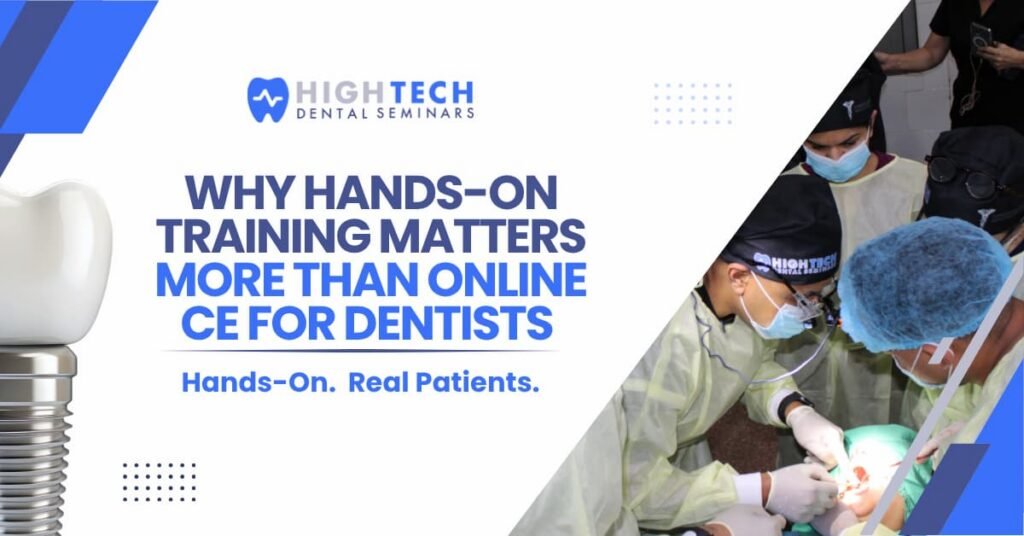
Some hands-on courses, including several offered through HTDS, involve live patient implant training with supervised work under an instructor’s direct guidance. This gives dentists a chance to build comfort with a technique in a real clinical setting, with support available at every step, rather than practicing alone for the first time once they are back in their own office.
This kind of practice is not something a model or a video can substitute for. It does not promise a specific result for any individual dentist’s future patients. What it offers is structured, supervised repetition, which is how most hands-on clinical skills are actually built.
How to Decide What You Actually Need
A useful test: ask whether the skill you are learning is something you could verify just by watching, or something you would only trust yourself with after doing it under supervision. Case planning and diagnosis often fall in the first category. Physical technique, like implant placement or aligner attachment bonding, usually falls in the second.
Most dentists end up using both formats over the course of their career, choosing online CE for knowledge-heavy topics and hands-on courses when a new physical skill is on the table, and our clear aligner course is a good example of how that choice plays out for a specific skill.
Frequently Asked Questions
Q: Does hands-on training count for the same CE credit as online courses?
A: Credit hours depend on your provincial regulator’s rules and the specific course, so check your college’s requirements before registering for either format, or contact us directly if you’re unsure how a specific course applies to your renewal cycle.
Q: Is hands-on training worth it if I already have implant experience?
A: Even experienced dentists use hands-on courses, including our Advanced Dental Implant Course for those with prior experience, to refine technique or learn a new system, since direct feedback can catch small habits that are hard to notice on your own.
Q: How much live-patient time is included in a typical hands-on course?
A: This varies by course. For one example of what that actually looks like day to day, see our breakdown of what the three days of the Step-by-Step Clear Aligners Course actually cover. Check the specific course description for details on supervised patient time before registering.
If a physical skill is what you are trying to build this year, browse HTDS’s upcoming hands-on implant courses and see which one fits your schedule.