
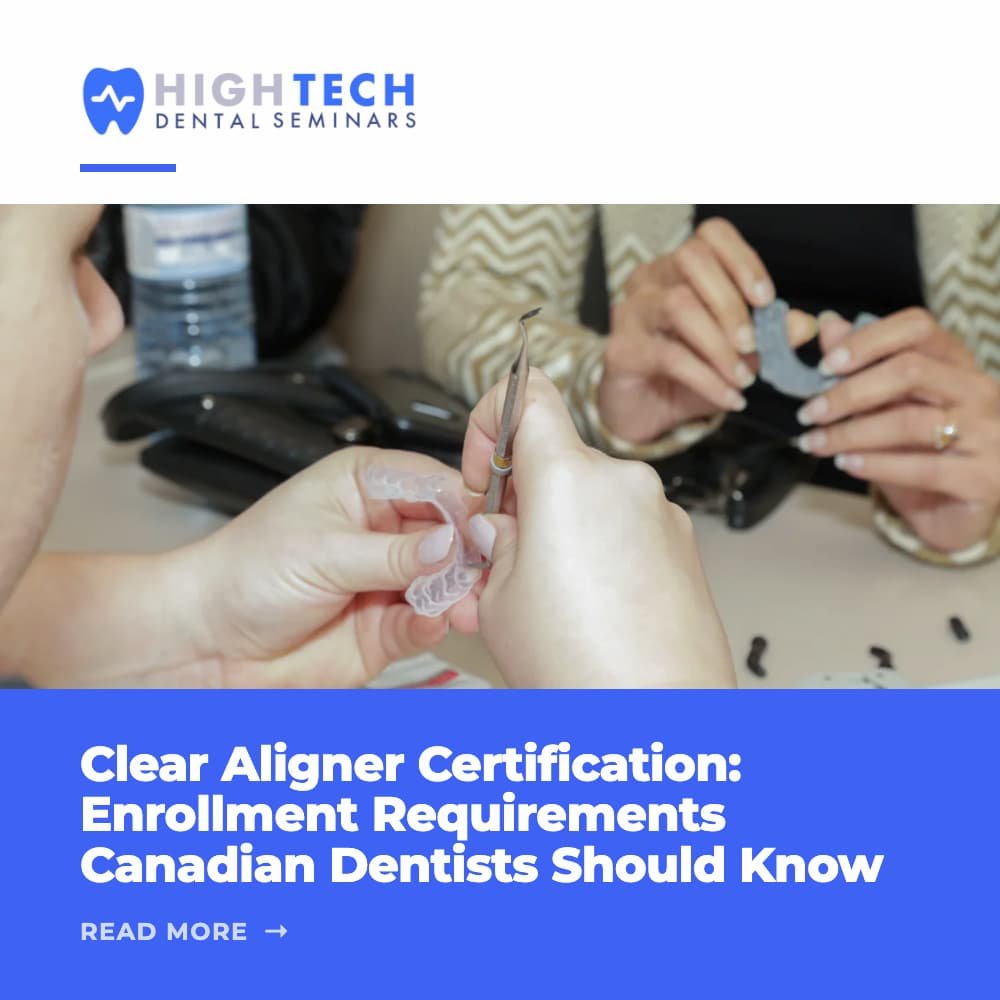
Integrating clear aligner therapy into a general dental practice represents one of the most valuable clinical and financial expansions available to modern dental professionals. However, before offering orthodontic aligner treatments to patients, practitioners must navigate a structured landscape of educational prerequisites, hands-on clinical training, and provincial regulatory compliance.
At High Tech Dental Seminars, we provide comprehensive, evidence-based training designed to empower Canadian dentists with the advanced diagnostic and biomechanical skills required to deliver predictable orthodontic outcomes.
This comprehensive guide details the core certification course requirements for Canadian dentists, explores provincial regulatory considerations, outlines essential curriculum components, evaluates patient selection guidelines, reviews advanced biomechanical mechanics, analyzes practice economics, examines patient communication standards, and reviews critical retention protocols.
Clear Aligner Certification: What Are the Core Requirements in Canada?
Clear aligner certification for Canadian dentists requires holding an active, unrestricted dental licence with a provincial regulatory body, completing a structured continuing education program combining theoretical biomechanics and hands-on clinical training, and maintaining professional liability insurance that encompasses minor orthodontic procedures.
Summary of Aligner Certification Requirements
Requirement Category | Standard Aligner Certification Criteria | Clinical or Administrative Objective |
Professional Licensure | Active license in good standing with a provincial dental college | Establishes legal authority to practice dentistry and perform minor tooth movement in Canada. |
Didactic Training | 15 to 30 hours of lectures on biomechanics, biology of tooth movement, and staging | Establishes foundational knowledge in orthodontic diagnosis and treatment planning. |
Hands-On Simulation | Practical workshops covering IPR, attachment placement, and digital scanning | Develops tactile proficiency in clinical execution and patient chairside procedures. |
Case Mentorship | Submission and review of live or simulated patient treatment cases | Ensures practical competency under the guidance of experienced orthodontists. |
Licensing and Regulatory Prerequisites for Canadian Dentists
Before enrolling in a clear aligner certification course, practitioners must verify their standing within the Canadian healthcare framework. Dentistry in Canada is provincially regulated, meaning educational standards and scope of practice interpretations are governed by provincial dental colleges, such as the Royal College of Dental Surgeons of Ontario (RCDSO).
1. Active Provincial Licensure
Participants must be licensed dentists in good standing. General dentists are fully authorized to perform minor tooth movement and clear aligner therapy provided they possess adequate training and competence, aligning with core educational standards established by organizations like the National Dental Examining Board of Canada.
2. Malpractice and Professional Liability Insurance
Offering orthodontic treatments requires verifying that your current professional liability protection extends to clear aligner therapy. Dentists should consult their provincial protective associations to ensure their policy adequately covers orthodontic scope expansions.
3. Commitment to Continuing Education (CE)
Most provincial dental colleges mandate a specific number of continuing education hours every three to five years. Enrolling in a rigorous aligner certification program not only builds clinical competence but also fulfills mandatory CE credit requirements.
Core Curriculum Standards: Didactic Versus Hands-On Training
A high-quality certification program must strike a balance between theoretical academic instruction and practical, hands-on clinical application. Understanding complex biological tooth movement cannot be achieved through online modules alone; it requires direct peer collaboration and simulation practice.
Didactic Lecture Components
- Biomechanics of Tooth Movement: Understanding how forces applied by clear aligners affect the periodontal ligament, alveolar bone remodeling, and root resorption risks.
- Diagnosis and Case Selection: Differentiating between mild-to-moderate malocclusions suitable for general practice and complex skeletal discrepancies requiring specialist referral to an orthodontist.
- Digital Treatment Planning: Mastering software platforms to evaluate staging, velocity, and final occlusal contacts.
Hands-On Clinical Workshops
- Interproximal Reduction (IPR): Practicing precise enamel reduction techniques using calibrated gauges and oscillating strips on typodont models.
- Attachment Placement and Bonding: Learning isolation protocols, etching, bonding, and composite placement for optimized aligner retention.
- Intraoral Scanning Integration: Transitioning from traditional PVS impressions to high-speed digital intraoral scanners for maximum treatment accuracy.
Essential Clinical Competencies Covered in Aligner Training
To achieve predictable, clinically sound results, certified dentists must master several core procedural competencies during their training continuum.
1. Accurate Malocclusion Classification
Dentists learn to diagnose Class I, II, and III malocclusions, anterior crossbites, deep overbites, open bites, and severe dental crowding. Proper classification ensures that cases chosen for general practice fall well within achievable boundaries.
2. Precision Interproximal Reduction (IPR)
IPR creates microscopic spaces between teeth, allowing crowded arches to align without excessive flaring. Training covers exact millimeter thresholds, safety strips, and patient management during mechanical or manual stripping.
3. Attachment and Power Ridge Placement
Attachments are small composite buttons bonded to teeth to facilitate complex movements like root uprighting, extrusion, and derotation. Training teaches practitioners how to select attachment geometries tailored to specific biomechanical demands.
Patient Selection Criteria and Clinical Contraindications
Choosing the right patient case is the single most critical factor determining success in clear aligner therapy. Certification training teaches practitioners how to screen prospective patients rigorously.
Suitable Cases for General Practice
- Mild to moderate dental crowding (up to 6 millimeters per arch).
- Mild spacing and generalized diastemas.
- Simple relapse cases where patients previously wore braces but experienced shifting.
- Minor anterior crossbites or localized dental rotations.
Complex Cases Requiring Specialist Referral
- Severe skeletal discrepancies (Class II or Class III jaw malformations).
- Anterior or posterior open bites requiring vertical skeletal control.
- Impacted teeth or severe root angulations requiring multi-planar bodily movement.
- Active periodontal disease or compromised alveolar bone support that contraindicates orthodontic force application.
Advanced Biomechanics: Managing Extrusion, Intrusion, and Rotations
While simple tipping movements are straightforward, clear aligners exert push forces rather than pull forces, making complex bodily movements mechanically challenging. Advanced training covers the physics of aligner biomechanics.
Extrusion and Vertical Control
Pulling a tooth downward out of the socket is historically difficult for removable plastic trays. Certification courses teach how to design optimized extrusion attachments and incorporate vertical elastic hooks to achieve predictable vertical control.
Managing Difficult Rotations
Rounded teeth, such as mandibular premolars and maxillary canines, are notoriously difficult to rotate with smooth aligner walls. Training details the precise placement of horizontal rectangular attachments and active power ridges to generate the couple forces needed for true root rotation.
Navigating Mid-Course Corrections and Refinement Trays
Even with meticulous planning, biological variation can occasionally cause teeth to stop tracking with their prescribed aligner trays. Recognizing and managing tracking loss is a core competency taught in certification programs.
Identifying Tracking Inaccuracies
A tracking loss occurs when a clear aligner no longer seats fully against the incisal edges or occlusal surfaces of the teeth, leaving an air gap of one millimeter or more. Dentists learn to evaluate whether minor compliance issues caused the lag or if biological resistance requires active intervention.
Executing a Mid-Course Refinement
When tracking failure occurs, practitioners must halt progression, take a new digital scan, and submit a refinement request to update the remaining treatment stages. Training guides dentists through analyzing why the tracking failure occurred and modifying attachment strategies for the subsequent trays.
Patient Communication, Education, and Informed Consent Protocols
Managing patient expectations is just as critical as managing biological tooth movement. Clear aligner certification emphasizes structured patient communication strategies to ensure high case satisfaction.
Visualizing Outcomes with Digital Simulation
Utilizing software tools that project 3D pre-treatment and post-treatment visual models helps patients instantly understand their malocclusion and visualize their future smile. This visual clarity significantly boosts treatment case acceptance rates.
Establishing Compliance Expectations
Because clear aligners are removable appliances, patient compliance dictates treatment speed and accuracy. Dentists are trained to educate patients on the mandatory 20-to-22 hour daily wear rule, proper tray cleaning maintenance, and the consequences of losing or damaging aligners.
Troubleshooting Stubborn Tooth Movements and Interdisciplinary Coordination
Even experienced practitioners encounter stubborn teeth that resist planned staging trajectories. Certification programs provide diagnostic frameworks for overcoming clinical roadblocks.
Overcoming Resistance in Severe Rotations
When a tooth refuses to rotate, dentists learn to evaluate whether auxiliary power ridges, additional attachment surface area, or segmented interproximal reduction is required to relieve binding contact points.
Interdisciplinary Treatment Planning
Certain cosmetic alignment cases require seamless coordination with other dental specialties. Training covers synchronizing aligner therapy with periodontal crown lengthening, restorative bonding, or implant placement staging to ensure comprehensive oral rehabilitation.
Long-Term Retention Strategies: Fixed Retainers Versus Removable Trays
Achieving a straight smile is only half the battle; maintaining that alignment permanently requires a structured retention protocol that counters natural biological tooth memory.
Fixed Lingual Retainers
Bonding a custom stainless steel wire directly to the lingual surfaces of anterior teeth provides permanent 24-hour retention against crowding relapse, particularly in the mandibular arch where post-treatment shifting is most aggressive.
Removable Vacuum-Formed Retainers
Clear removable retainers worn nightly safeguard overall arch alignment while allowing patients to maintain normal hygiene routines. Dentists learn how to select retainer thickness and establish replacement schedules for long-term stability.
Retention Strategy Matrix
Retainer Type | Primary Clinical Application | Longevity & Maintenance |
Bonded Lingual Wire | Permanent retention for mandibular and maxillary anteriors | Lasts many years; requires careful interdental flossing. |
Clear Vacuum Trays | Full coverage nighttime retention across entire dental arch | Replaced every 1 to 2 years due to normal wear and tear. |
Hawley Acrylic Retainer | Adjustable wire retainer with acrylic palatal coverage | Highly durable; allows natural settling of posterior occlusion. |
Technological Infrastructure: Software, Scanners, and Digital Imaging Requirements
Integrating clear aligner therapy smoothly into a dental practice requires more than clinical skill; it depends on establishing a reliable, efficient digital hardware and software stack.
Intraoral Scanners and Digital Impressions
Traditional polyvinyl siloxane impressions are increasingly being replaced by fast, accurate intraoral scanners. Digital scanning improves patient comfort, eliminates material distortion, and enables instant transmission of STL files to aligner laboratories or treatment planning software.
Treatment Planning Software Integration
Practitioners must be proficient in navigating cloud-based treatment management portals. These software applications allow dentists to review 3D digital set-ups, adjust tooth movements, request mid-course refinements, and communicate directly with laboratory technicians.
Hardware and Software Investment Matrix
Technological Asset | Primary Function in Aligner Workflow | Estimated Practice Impact |
Intraoral Scanner | Captures high-resolution 3D digital impressions of dental arches | Eliminates gagging, reduces material costs, speeds up submission. |
3D CBCT Imaging | Evaluates root position, bone volume, and cortical plate boundaries | Enhances diagnostic safety for complex root movements. |
Cloud Treatment Portal | Visualizes 3D tooth staging and allows treatment modifications | Empowers precise doctor control over final bite outcomes. |
Financial ROI and Practice Economics of Adding Clear Aligner Therapy
Beyond clinical fulfillment, clear aligner certification offers a powerful catalyst for practice growth and revenue diversification. Understanding the underlying financial economics helps practice owners budget effectively for training and technology.
Case Fees and Revenue Potential
Clear aligner cases typically command substantial comprehensive restorative fees, positioning aligner therapy as one of the highest-value services in a general dental practice. Because aligner check-up appointments are remarkably short and non-invasive, chairside time is optimized, allowing dentists to treat multiple orthodontic patients efficiently within a standard operating day.
Case Acceptance and Patient Retention
Patients prefer completing cosmetic and functional dental procedures within the familiar environment of their general dental home. Offering aligner therapy prevents patients from seeking treatment elsewhere, keeping auxiliary whitening, restorative bonding, and post-treatment maintenance revenues in-house.
Practice Economics and ROI Overview
Financial Metric | Typical Aligner Practice Impact | Strategic Practice Benefit |
Chairside Time per Check-up | 10 to 15 minutes | High patient throughput with minimal physical strain on the provider. |
Average Case Fee Range | Moderate to High premium fee structure | Substantially boosts monthly production averages per operatory. |
Cross-Referral Retention | Retains patients in-house | Prevents patient leakage to specialized or direct-to-consumer orthodontics. |
To explore broader technological advancements that complement aligner workflows, review our guide on digital dentistry training in Canada or explore foundational learning through our orthodontic continuing education courses.
Risk Management, Informed Consent, and Malpractice Mitigation
Operating within the scope of minor orthodontics requires rigorous adherence to patient safety protocols, transparent communication, and comprehensive documentation to protect both the patient and the practitioner.
Comprehensive Informed Consent
Before initiating treatment, patients must sign a detailed informed consent document outlining the biological realities of orthodontic movement. Discussions must cover potential risks such as transient root resorption, temporary tooth sensitivity, gingival inflammation, and the possibility of relapse if retention protocols are ignored.
Managing Patient Compliance Expectations
Clear aligners are removable, placing the ultimate responsibility for success in the hands of the patient. Clear communication regarding the mandatory 20-to-22 hours of daily wear time prevents poor tracking, mid-course corrections, and extended treatment timelines.
Long-Term Retention Protocols
Teeth possess a natural biological memory and will attempt to return to their original pre-treatment positions once forces are removed. Establishing a lifelong retention protocol, including bonded lingual retainers and clear removable trays, is essential to secure your clinical results.
Frequently Asked Questions
Do general dentists in Canada need a specialty degree to offer clear aligners?
No. General dentists in Canada are legally permitted to provide clear aligner therapy and minor orthodontic treatments within their general scope of practice, provided they have acquired adequate continuing education and clinical training to ensure patient safety and competence.
How many hours does a standard aligner certification course take?
Most comprehensive certification programs range between 20 and 40 total continuing education hours, split between online or in-person didactic lectures, hands-on typodont workshops, and supervised case review sessions.
Can dental hygienists or assistants attend clear aligner training?
While auxiliary team members often attend specialized support modules regarding scanning, patient education, and appointment management, formal clinical certification and treatment planning authorization remain strictly restricted to licensed dentists.
What is the difference between brand-specific certification and independent training?
Brand-specific courses are sponsored by particular aligner manufacturers and focus primarily on their proprietary software interface. Independent educational seminars provide broad biomechanical training applicable across multiple aligner systems, fostering unbiased diagnostic mastery.
How does clear aligner training impact dental malpractice insurance?
Most Canadian dental protective associations require proof of continuing education when updating your practice profile to include minor orthodontics. Completing a recognized certification course demonstrates due diligence and adherence to professional standards.
Take the Next Step in Your Professional Development
Elevating your clinical capabilities with advanced clear aligner training enhances patient care, increases practice retention, and expands your clinical repertoire.
To explore upcoming course dates, curriculum details, and registration pathways, visit our primary clear aligner certification page or connect with our academic team at High Tech Dental Seminars today.